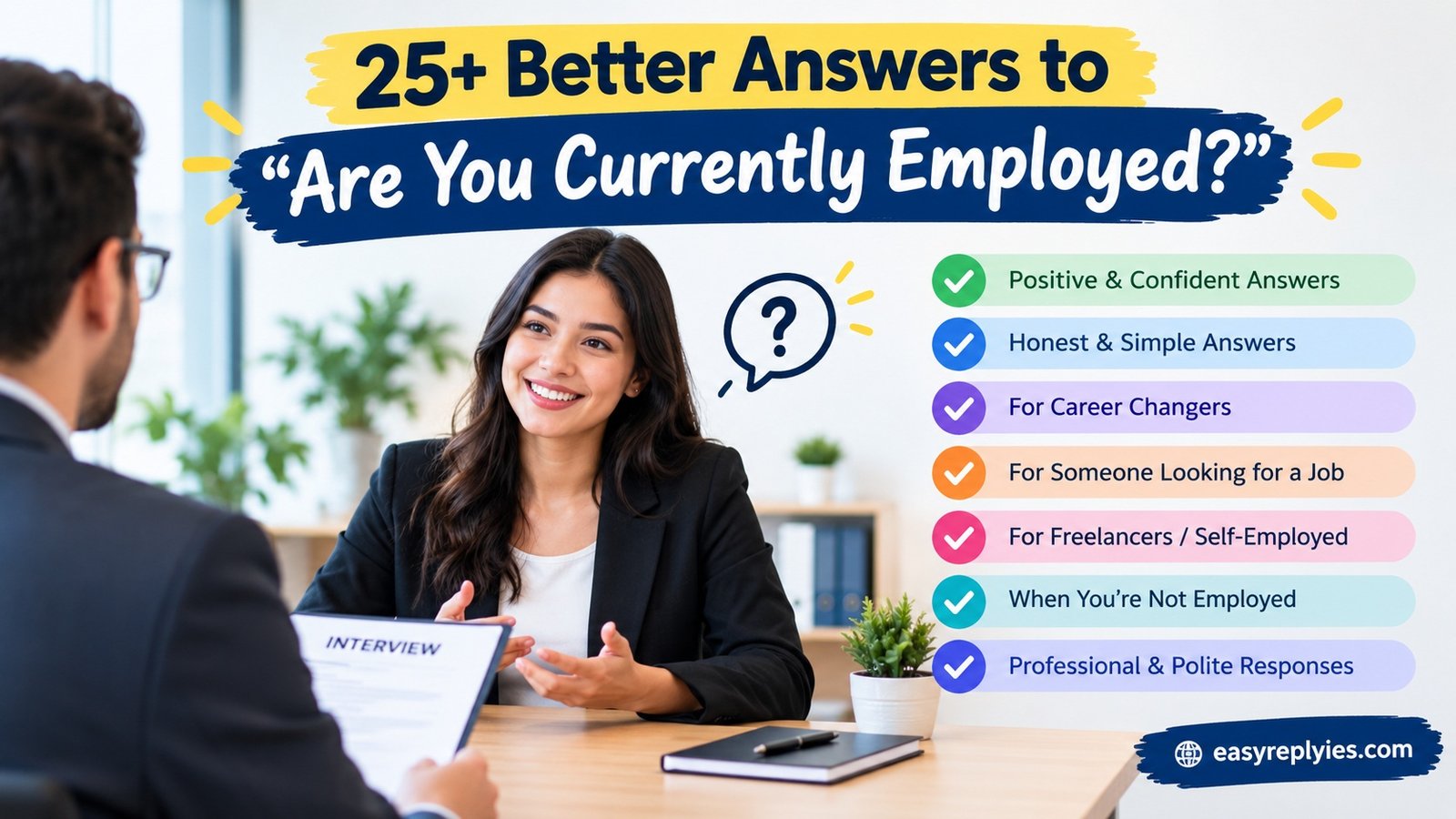
When you are asked “Are You Currently Employed?”, your response should match the situation and why the person is asking. A recruiter, employer, or hiring manager may want your current employment and employment status, while a friend may be curious about what you are doing lately. In professional conversations, a straightforward answer can show confidence, strong communication, and professionalism.
If you are currently employed, you can say “Yes” and briefly explain your job, role, or work. If the answer is “No”, you can mention your job search, opportunities, or that you are exploring opportunities.
For those between jobs, freelancing, studying, job hunting, or taking time away from work, a polished response can help you confidently navigate the question without feeling uncomfortable or having to stumble over your words. During an interview, connect your answer to the question with availability, start date, or notice period. If an employer asks “When can you start working?”, explain whether you have immediate availability or are ready to start tomorrow, while considering the employer’s expectations and needs. In a casual text or dating conversation, a short, relaxed, and natural reply may fit better. These 10 better answers cover different situations, including funny, confident, and professional situations, while helping you reflect positively and leave a lasting impression without sounding overly detailed, defensive, or tiring.
1. A Simple and Direct Answer
When someone genuinely wants to know whether you have a job right now, there is no need to overthink the response. A clear answer is usually the strongest option, especially when the conversation is straightforward.
If you are employed, say so. If you are not, you can state that honestly without turning the answer into an explanation of your entire career history.
Meaning
This response communicates your current employment status without unnecessary details.
Tone
Direct, neutral, and confident.
Example
Recruiter: Are you currently employed?
You: Yes, I am. I’m currently working as a customer support specialist.
Best Use
Use this when speaking with recruiters, acquaintances, professional contacts, or anyone who simply needs a factual answer.
Quick tip: Answer the question first. Add more information only if the other person asks or if the context makes it useful.
2. “Yes, I’m Currently Working.”
Sometimes the most natural answer is simply a slightly fuller version of “yes.” This works particularly well when you want to sound comfortable and open to continuing the conversation.
Meaning
You are confirming that you currently have employment.
Tone
Friendly, confident, and conversational.
Example
Friend: Are you currently employed?
You: Yes, I’m currently working. Things have been pretty busy lately.
Friend: Oh, nice. What are you doing?
You: I’m working in marketing at the moment.
Best Use
This is suitable for casual conversations, networking, social situations, and everyday questions.
3. “Yes, I’m Working Full-Time.”
If the person seems to be asking about the nature of your employment rather than simply whether you have a job, adding “full-time” gives them useful context.
Meaning
You are confirming employment while clarifying that your current role is full-time.
Tone
Clear, professional, and matter-of-fact.
Example
Someone: Are you currently employed?
You: Yes, I’m working full-time at a software company.
Best Use
Use this when discussing your career, schedule, lifestyle, or professional background.
4. “I’m Working Part-Time Right Now.”
If you have a part-time position, there is no reason to make your answer sound apologetic. Part-time work is still employment, and a straightforward response sounds more confident than an overly complicated explanation.
Meaning
You are employed but currently working fewer hours than a typical full-time position.
Tone
Honest, relaxed, and confident.
Example
Neighbor: Are you currently employed?
You: Yes, I’m working part-time right now while I focus on a few other projects.
Best Use
This works well in casual conversations or when your employment status is relevant but does not require extensive detail.
5. “I’m Self-Employed at the Moment.”
Traditional employment is not the only way to answer this question. If you run your own business, provide services independently, or work for yourself, “self-employed” is often the clearest response.
Meaning
You work independently rather than being employed by a conventional employer.
Tone
Professional, confident, and concise.
Example
Acquaintance: Are you currently employed?
You: I’m self-employed at the moment. I do freelance web design for several clients.
Best Use
Use this in networking, professional introductions, social conversations, or whenever someone is asking about your work.
6. “I’m Freelancing Right Now.”
Freelancing can be a better description than simply saying you are “working” if you take projects from different clients.
Meaning
You currently earn income through independent projects or contract work.
Tone
Casual, modern, and confident.
Example
Friend: So, are you currently employed?
You: I’m freelancing right now and working with a few different clients.
Friend: That actually sounds pretty interesting.
Best Use
This is especially natural when talking with friends, people in your industry, or someone getting to know you.
Better choice: If your freelance work is your primary source of income, describing yourself as a freelancer is often more informative than simply saying you are unemployed.
7. “I’m Between Jobs Right Now.”
If you recently left a position and are looking for another one, “between jobs” is a natural way to describe the situation without making it sound unnecessarily negative.
Meaning
You are not currently employed but expect to work again and may already be searching for your next opportunity.
Tone
Calm, positive, and professional.
Example
Person: Are you currently employed?
You: I’m between jobs right now. I recently finished my last role and I’m looking for the right next opportunity.
Best Use
This is useful in networking conversations, social situations, and professional settings.
It can be particularly helpful when you want to acknowledge the situation without inviting assumptions about why you left your previous job.
8. “Not Right Now, but I’m Job Hunting.”
If you are actively searching for work, saying so gives the other person a more complete picture.
Meaning
You are currently unemployed but actively looking for employment.
Tone
Honest, proactive, and confident.
Example
Recruiter: Are you currently employed?
You: Not right now, but I’m actively job hunting and looking for a position in project management.
Best Use
This is especially appropriate when talking with recruiters, professional contacts, former colleagues, or people who may know about job opportunities.
Quick tip: Mention the type of work you want if the person might be able to help. It turns a simple status update into a useful networking opportunity.
9. “I’m Currently Looking for My Next Opportunity.”
This answer puts more emphasis on the future than on being unemployed. It can be a polished option when you want to keep the conversation career-focused.
Meaning
You are currently searching for a suitable professional opportunity.
Tone
Positive, professional, and forward-looking.
Example
Hiring Manager: Are you currently employed?
You: I’m not at the moment. I’m currently looking for my next opportunity, particularly in operations.
Best Use
Use this during networking, interviews, career conversations, or professional introductions.
10. “I’m Taking Some Time to Figure Out My Next Step.”
Not everyone who is unemployed is immediately applying for jobs. Sometimes a person has intentionally taken a break to reassess their career.
Meaning
You are currently not employed and are considering what you want to do next.
Tone
Thoughtful, calm, and self-assured.
Example
Friend: Are you currently employed?
You: Not at the moment. I’m taking some time to figure out my next step before jumping into another role.
Best Use
This is a good choice with friends, relatives, acquaintances, or people you trust.
It is less suitable for a formal job interview unless you can explain your career plans clearly.
11. A Professional Answer for a Job Interview
When an interviewer asks whether you are currently employed, keep your response factual. They may be trying to understand your availability, notice period, or current professional situation.
Meaning
You are giving the interviewer the employment information they need while keeping the conversation focused on your qualifications.
Tone
Professional, concise, and confident.
Example
Interviewer: Are you currently employed?
You: Yes, I’m currently employed as a financial analyst. My notice period is four weeks.
Best Use
Use this in interviews, recruiter calls, applications, and other formal employment discussions.
Better choice: If your current job affects when you can start, mention your availability after answering the employment question.
12. If You Are Employed but Open to New Opportunities
You may have a job and still be looking elsewhere. You do not need to hide that fact, but your answer should remain professional.
Meaning
You are currently employed but interested in finding a different or better-suited opportunity.
Tone
Professional, composed, and career-focused.
Example
Recruiter: Are you currently employed?
You: Yes, I’m currently employed, but I’m open to exploring opportunities that are a better fit for my long-term goals.
Best Use
This is particularly useful when speaking with recruiters or potential employers.
Avoid criticizing your current employer in the same answer. Keep the focus on what you are looking for next.
13. A Short Text Response
If someone asks this over text, you probably do not need to send a paragraph. A short, natural answer is usually better.
Meaning
You are giving the person the information they asked for without overexplaining.
Tone
Casual and straightforward.
Example
Them: Are you currently employed?
You: Yeah, I’m working full-time right now.
Or:
Them: Are you currently employed?
You: Not at the moment. I’m looking for something new.
Best Use
Use these answers for texting, messaging apps, social media conversations, or casual chats.
Read More:25 Best Responses When Someone Says They Like You
14. A Friendly Answer That Keeps the Conversation Going
Sometimes the question is not really about employment status. The person may be trying to learn more about your life. In that case, answer and then give them something to respond to.
Meaning
You provide your employment status while inviting a more natural conversation.
Tone
Friendly, open, and conversational.
Example
Them: Are you currently employed?
You: Yeah, I’m working in graphic design these days. I’ve actually been enjoying it more than I expected.
Them: Really? What kind of projects do you work on?
Best Use
This works well with new friends, acquaintances, networking contacts, and people getting to know you.
15. A Funny Response for Close Friends
If the person is a close friend and the conversation is clearly playful, you can add some humor.
Meaning
You are answering the question while making the conversation lighter.
Tone
Funny, playful, and casual.
Example
Friend: Are you currently employed?
You: Technically, yes. My boss and I have been in a very committed relationship for years.
Best Use
Use this with friends who understand your humor.
Watch the tone: Humor can become awkward if the other person is asking for serious information, particularly in a professional setting.
16. A Self-Deprecating but Lighthearted Reply
If you are between jobs and comfortable joking about it, a gentle self-aware response can work with close friends.
Meaning
You are acknowledging that you are currently unemployed without treating the situation as a source of shame.
Tone
Playful, relaxed, and self-aware.
Example
Friend: Are you currently employed?
You: Not currently. I’m employed by my alarm clock, but unfortunately it doesn’t pay.
Best Use
This is best reserved for friends or casual conversations where humor is already part of the relationship.
It is not a good choice for a recruiter, interviewer, or someone who needs an accurate answer.
17. A Confident Answer When You Are Unemployed
Being unemployed does not mean you have to sound embarrassed. A confident answer can acknowledge your current situation while showing that you are moving forward.
Meaning
You are currently without a job, but you are comfortable discussing it and focused on what comes next.
Tone
Confident, mature, and positive.
Example
Someone: Are you currently employed?
You: No, not right now. I’m using the time to focus on my job search and find a role that’s genuinely a good fit.
Best Use
This works well in professional networking, social conversations, and discussions with acquaintances.
18. A Polite Answer When You Prefer Privacy
Employment can be personal, and you are not obligated to give a detailed account of your career to everyone who asks.
Meaning
You are responding respectfully while keeping personal details private.
Tone
Polite, reserved, and firm.
Example
Acquaintance: Are you currently employed?
You: I’m figuring out a few things professionally at the moment, but I appreciate you asking.
Best Use
Use this when the question feels intrusive or when you simply do not want to discuss your employment status.
You can remain polite without giving information you are uncomfortable sharing.
19. When You Are Studying Instead of Working
Students are sometimes asked whether they are employed even though their main focus is education. You can clarify your situation without making it sound like you have nothing going on.
Meaning
You are explaining that education is currently your primary commitment.
Tone
Clear, casual, and informative.
Example
Someone: Are you currently employed?
You: Not right now. I’m currently studying full-time, so that’s where most of my attention is going.
Best Use
This works well with acquaintances, relatives, friends, and casual professional conversations.
20. When You Are Working and Studying
If you have a job while attending school or completing a course, mentioning both gives the other person a clearer picture.
Meaning
You are employed while also pursuing education.
Tone
Confident and conversational.
Example
Them: Are you currently employed?
You: Yes, I work part-time while I finish my degree.
Best Use
This is useful in casual introductions, networking, social conversations, and discussions about your schedule.
21. A Casual Dating Response
On a date, the question may be part of getting to know your lifestyle rather than evaluating your résumé. Your answer can therefore be more conversational.
Meaning
You are answering honestly while keeping the discussion relaxed.
Tone
Casual, confident, and open.
Example
Date: So, are you currently employed?
You: Yeah, I am. I work in marketing, although I promise I don’t spend all day trying to sell people things.
Date: That’s probably a good thing.
Best Use
Use this when dating or chatting with someone who is getting to know you.
Keep humor natural rather than forcing a clever line.
22. A Playful or Slightly Flirty Response
If there is already clear romantic chemistry, you can make the answer a little more playful.
Meaning
You are answering the question while adding personality to the conversation.
Tone
Playful, confident, and lightly flirty.
Example
Them: Are you currently employed?
You: I am. But if this conversation keeps going well, I may need to make “talking to you” my second job.
Best Use
Only use this when the conversation already has a flirtatious tone.
A line like this can feel charming in the right context but awkward if the relationship is still strictly formal or unfamiliar.
23. A Clever Answer Without Being Rude
Sometimes you want something more memorable than “yes” without turning the answer into a joke.
Meaning
You are responding with personality while still answering the actual question.
Tone
Clever, confident, and light.
Example
Them: Are you currently employed?
You: Yes. I’m gainfully occupied and occasionally pretending I have my inbox under control.
Best Use
This works in relaxed professional networking, conversations with acquaintances, or casual social situations where a little humor is appropriate.
24. When Someone Is Being Nosy
If someone asks about your employment in a way that feels judgmental or intrusive, you can set a boundary without becoming confrontational.
Meaning
You are politely making it clear that your employment situation is personal.
Tone
Calm, firm, and respectful.
Example
Person: So, are you actually working right now?
You: I’m handling my career situation in my own way, but I appreciate your concern.
Best Use
Use this when someone is being intrusive, judgmental, or overly interested in your personal affairs.
Better choice: A calm boundary is usually more effective than an aggressive comeback, especially when you may have to continue interacting with the person.
25. An Answer That Turns the Question Into a Conversation
If you want to move beyond a simple yes-or-no exchange, answer briefly and ask something relevant in return.
Meaning
You are sharing your status while encouraging a two-way conversation.
Tone
Friendly, engaged, and natural.
Example
Them: Are you currently employed?
You: Yes, I’m working in software development right now. What about you—what kind of work are you into?
Best Use
This is excellent for networking events, meeting new people, social gatherings, dating conversations, and online chats.
It prevents the interaction from feeling like an interview.
How to Choose the Right Answer
The best response is rarely about finding the cleverest sentence. It is about matching your answer to the person asking, the reason they are asking, and the relationship you have with them.
Consider these three questions before responding:
1. Why are they asking?
A recruiter needs accurate employment information. A friend may simply be making conversation.
2. How much information do they actually need?
If the question is casual, one sentence may be enough. If it is related to a job opportunity, relevant details can be helpful.
3. What tone does the conversation have?
A funny response may work with a close friend but sound unprofessional during an interview.
When in doubt, start with a simple factual answer and let the other person guide the conversation.
What to Say If You Are Currently Employed
If you have a job, you generally do not need to make your response complicated.
Some natural options include:
- “Yes, I’m currently employed.”
- “Yes, I’m working full-time right now.”
- “I’m currently working in sales.”
- “Yes, I have a full-time position.”
- “I’m working part-time at the moment.”
- “Yes, I’m currently working as a designer.”
- “I’m employed, but I’m open to new opportunities.”
The best version depends on how much context is useful.
For example, “Yes, I’m employed” is perfectly adequate in a casual conversation, while “Yes, I’m currently employed, and my notice period is four weeks” is more useful when speaking with a recruiter.
What to Say If You Are Not Currently Employed
You do not have to describe unemployment in a negative or apologetic way.
Try responses such as:
- “Not at the moment, but I’m looking for my next opportunity.”
- “I’m between jobs right now.”
- “I’m currently job hunting.”
- “I’m taking some time to decide what I want to do next.”
- “I recently left my previous role and I’m exploring new opportunities.”
- “I’m not working right now, but I’m actively looking.”
- “I’m focusing on a few personal and professional projects at the moment.”
Choose the wording that accurately reflects your situation.
If you are actively applying for jobs, “I’m currently job hunting” is clear. If you intentionally took a career break, “I’m taking some time to figure out my next step” may be more appropriate.
Better Answers for Professional Conversations
Professional situations usually call for clarity over cleverness.
If a recruiter or interviewer asks whether you are currently employed, avoid sarcastic jokes, vague answers, or unnecessary criticism of your current or former employer.
A useful structure is:
Employment status + relevant detail + availability, if necessary
For example:
“Yes, I’m currently employed as an account manager. I’m exploring opportunities with more responsibility, and I’d be available after a four-week notice period.”
Or:
“I’m not currently employed. I recently completed my previous role and am actively looking for positions in customer success.”
This approach answers the question directly while giving the other person useful context.
Better Answers for Text Messages
Text conversations usually work best when the response is short.
If you are employed:
“Yeah, I’m working full-time right now.”
If you are freelancing:
“I’m freelancing at the moment.”
If you are between jobs:
“Not right now. I’m looking for something new.”
If you are studying:
“Not currently. I’m focused on school right now.”
If you want to keep the conversation going:
“Yeah, I’m working in marketing these days. What about you?”
There is rarely a need to send a long explanation unless the person specifically asks for more information.
Funny Answers That Are Actually Appropriate
Humor can make an ordinary conversation more memorable, but context matters.
Good humor should still allow the other person to understand your actual situation.
For example:
“Yes, although my inbox seems to think I have three jobs.”
Or:
“Currently employed and currently negotiating with my alarm clock every morning.”
These work because they answer the question while adding personality.
Avoid jokes that make serious claims about your financial situation, insult your employer, or could be misunderstood by someone who does not know you well.
Respectful Ways to Avoid the Question
Sometimes you simply do not want to discuss your employment.
You can protect your privacy without sounding hostile.
Try:
“I’m keeping the details of my work situation private for now.”
Or:
“I’m figuring out my next professional move, but I’d rather not get into the details.”
Or, for a casual conversation:
“I’ve got a few things going on professionally, but I’m keeping that part of my life pretty private.”
These answers are particularly useful when the question feels intrusive.
You do not owe everyone a detailed explanation of your career.
Responses That Can Sound Awkward
Some answers may technically respond to the question but create an unnecessary impression.
“Why do you want to know?”
This can sound defensive if the person has asked an innocent question.
“That’s none of your business.”
This may be justified when someone is being deliberately intrusive, but it is unnecessarily harsh in ordinary conversation.
“I’m not working, unfortunately.”
The word “unfortunately” can make the answer sound more negative than necessary.
“I’m just unemployed right now.”
“Just” can unintentionally minimize everything else you are doing.
“I’m looking for literally anything.”
If you are speaking with a potential employer, this can make you sound unfocused. Be more specific about the type of opportunity you want.
The goal is not to hide your circumstances. It is to describe them accurately and confidently.
How to Sound Confident When You Are Between Jobs
Being between jobs can sometimes make people feel pressure to explain themselves. You do not need to apologize for your current situation.
Instead of:
“No, sadly I don’t have a job right now.”
Try:
“Not at the moment. I’m actively looking for my next opportunity.”
Instead of:
“I quit my job and now I have no idea what I’m doing.”
Try:
“I recently left my previous role and I’m taking some time to decide what I want to pursue next.”
The second versions do not hide reality. They simply present the situation with more clarity and self-confidence.
How to Respond When You Do Not Know the Person Well
When a stranger or new acquaintance asks about your employment, keep the answer brief unless you genuinely want to discuss your work.
For example:
“Yes, I work in education.”
Or:
“I’m currently freelancing.”
Or:
“I’m between jobs at the moment and exploring a few options.”
You can then decide whether you want to continue the topic.
There is no rule saying that answering a question means you have to provide every detail.
How to Make Your Answer Sound Natural
A natural answer usually follows the same principle as a natural conversation: say enough, but not too much.
If someone asks, “Are you currently employed?” they probably do not need your complete employment history.
Compare:
“Yes.”
with:
“Yes, I’m currently working full-time in accounting. I’ve been there for about two years.”
Both are correct, but the second gives more context.
Now compare an unnecessarily long answer:
“Well, technically I am employed, but things have changed a lot over the past few months, and before that I worked somewhere else…”
That may be appropriate if someone specifically asks about your career history, but it is excessive for a simple question.
A good rule: Start short. Expand only when the conversation calls for it.
Frequently Asked Questions
What is the best way to respond to “Are you currently employed?”
The best response depends on the context. If you are employed, answer directly and mention your role if relevant. If you are unemployed, you can say you are between jobs, job hunting, or looking for your next opportunity. In professional settings, prioritize accuracy and clarity.
How can I politely say that I am unemployed?
You can say, “I’m between jobs right now,” “I’m currently looking for my next opportunity,” or “I’m not employed at the moment, but I’m actively job hunting.” These phrases are honest without making the situation sound unnecessarily negative.
What is a funny response to “Are you currently employed?”
With close friends, you can use light humor such as, “Yes, although my inbox seems to think I have three jobs.” Keep jokes appropriate to the relationship, and avoid humorous answers when the person needs accurate professional information.
Should I explain why I am unemployed?
Not necessarily. If the conversation is casual, a short answer is usually enough. If you are speaking with a recruiter or potential employer, it may be useful to briefly explain your current situation and what kind of opportunity you are seeking.
How should I answer if I am self-employed?
Be direct. You could say, “I’m self-employed,” “I run my own business,” or “I’m freelancing at the moment.” If useful, briefly explain what kind of work you do.
What should I say if I do not want to discuss my employment?
You can politely establish a boundary. For example, “I’m figuring out a few things professionally, but I’d rather keep the details private for now.” You can be respectful without sharing information you are uncomfortable discussing.
Conclusion:
There is no single perfect answer to “Are you currently employed?” because the right response depends on context, relationship, and purpose. A recruiter needs a clear professional answer, while a friend may appreciate something more relaxed. If you are between jobs, freelancing, studying, or taking a career break, you can describe your situation honestly without sounding apologetic.
The safest approach is to answer the actual question first, then add context when it is useful. If you are unsure how much to say, keep it brief and let the other person ask a follow-up. Most importantly, choose wording that sounds like you rather than forcing a clever response that does not fit the conversation.








1 thought on “25 Better Answers to “Are You Currently Employed?””