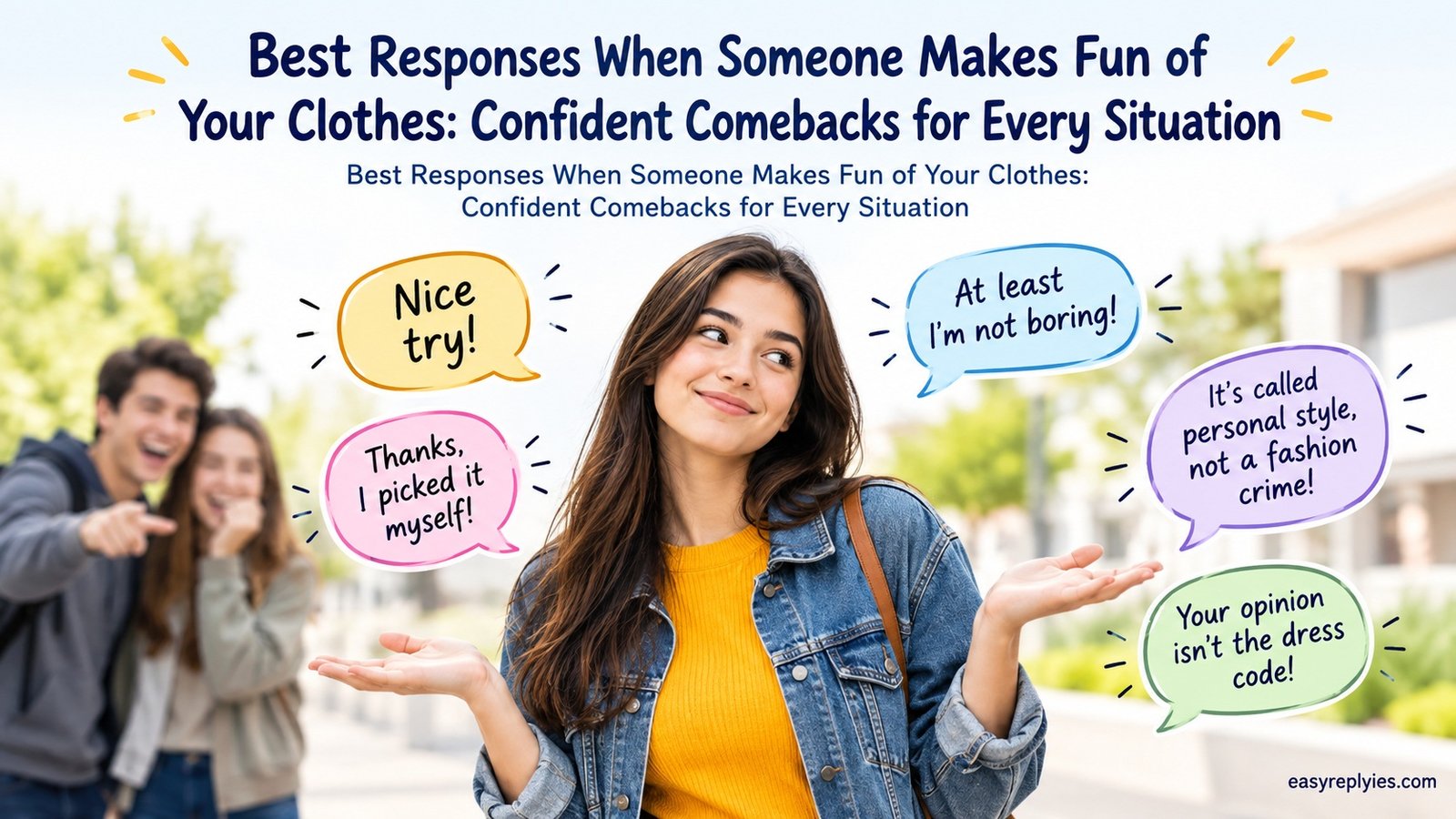
Best Responses When Someone Makes Fun of Your Clothes: Confident Comebacks for Every Situation helps you stay calm and confident with ease.
When someone makes fun of your clothes, you may suddenly do not know what to say, especially when joking with friends, dealing with teasing at school, hearing sarcastic comments at work, or facing remarks online. The right response can keep you calm, confident, witty, respectful, and self-assured. Instead of using a harsh insult, choose clever responses that help you handle different situations without losing your cool. If someone criticizes your outfit, fashion style, or personal taste, a funny comeback, classy reply, or confident one-liner can be the perfect reply. A comment can feel annoying, embarrassing, or funny, but the good news is that you can handle the situation without making things worse.
A clever comeback can help you stay calm, turn an awkward moment around, and use a simple answer when that is enough. You can avoid an argument, set a clear boundary when someone keeps criticizing you, and respond wisely when a friend makes a joke. These 25 ideas include funny responses, playful replies, sarcastic lines, and completely ridiculous options. If someone asks what are you wearing, they may be curious, flirting, or simply asking a simple question, so the reason behind the comment matters. A little sense of humor can turn a boring answer into a perfect chance to laugh and make an ordinary conversation more memorable. These creative ideas, mini stories, bold examples, and tips can help you understand when to use each response and when not to use it, so your answer feels natural rather than forced.
1. “Good Thing I Like What I’m Wearing”
This is one of the simplest ways to handle a clothing comment without becoming defensive. It shows that the other person’s opinion doesn’t control your confidence. Because the response is calm rather than aggressive, it works particularly well when someone is trying to get a reaction from you.
Meaning
You are making it clear that their opinion is not changing how you feel about your outfit.
Tone
Confident, calm, casual.
Example
Friend: That shirt really isn’t your best look.
You: Good thing I like what I’m wearing.
Best Use
Use this with friends, classmates, casual acquaintances, or anyone making a minor comment about your clothes. It is especially useful when you don’t want to turn the conversation into an argument.
2. “I Didn’t Realize I Needed Your Approval”
A little dry humor can make an unnecessary fashion critique lose its power. This response points out that the other person’s approval was never part of the decision.
Meaning
You are politely suggesting that your clothing choices don’t require someone else’s permission.
Tone
Sarcastic, confident, direct.
Example
Coworker: You’re actually wearing that today?
You: I didn’t realize I needed your approval.
Best Use
This works when someone is being openly judgmental rather than simply joking. In a professional setting, use it carefully because the sarcasm may sound sharper than intended.
3. “It’s Not Your Style, and That’s Okay”
Sometimes the best comeback isn’t really a comeback. This response turns criticism into a simple difference in taste.
Meaning
You acknowledge their opinion without accepting it as a fact.
Tone
Polite, mature, confident.
Example
Friend: I don’t understand why you wear clothes like that.
You: It’s not your style, and that’s okay. I like it.
Best Use
Choose this when you want to stay respectful, particularly around family members, coworkers, classmates, or people you don’t know well.
4. “At Least I’m Wearing Something I Enjoy”
This answer moves the conversation away from appearance and toward personal choice. It is confident without putting the other person down.
Meaning
Your clothes are about your comfort and enjoyment rather than satisfying everyone around you.
Tone
Positive, relaxed, self-assured.
Example
Someone: Those colors don’t even match.
You: Maybe not to you. At least I’m wearing something I enjoy.
Best Use
Good for everyday conversations when you want to stand your ground without sounding hostile.
5. “Thanks for Your Fashion Review”
If someone is constantly giving unsolicited opinions, playful sarcasm can acknowledge the comment without taking it seriously.
Meaning
You are humorously treating their criticism like an unwanted professional consultation.
Tone
Funny, sarcastic, playful.
Example
Friend: Those shoes definitely don’t belong with that outfit.
You: Thanks for your fashion review. I’ll file that away.
Best Use
Best among friends or people who understand your sense of humor. Avoid it if the person is already angry or if the situation is sensitive.
6. “I’m Dressing for Me, Not the Crowd”
This is a stronger response for situations where someone repeatedly tries to make you feel embarrassed about your appearance.
Meaning
You are establishing that your personal style is your decision.
Tone
Confident, direct, empowering.
Example
Person: Why do you always dress so differently?
You: I’m dressing for me, not the crowd.
Best Use
Use this when you want to end repeated criticism without insulting the other person.
7. “You Don’t Have to Wear It”
A simple statement can sometimes be more effective than a clever comeback.
Meaning
Your clothes are your choice, and the other person doesn’t have to wear them.
Tone
Calm, direct, slightly playful.
Example
Sibling: I would never wear that.
You: That’s fine. You don’t have to wear it.
Best Use
Ideal for family, friends, or casual conversations where someone is criticizing an outfit they don’t personally like.
8. “Different Taste Makes Life More Interesting”
This response reframes disagreement as something normal rather than something that needs to be argued about.
Meaning
People have different preferences, and that’s perfectly acceptable.
Tone
Friendly, mature, positive.
Example
Friend: Your style is so different from mine.
You: That’s what makes it interesting. Imagine if everyone dressed exactly the same.
Best Use
Use this when the comment is more teasing than insulting and you want to keep the conversation friendly.
9. “I’ll Survive the Fashion Criticism”
A little self-aware humor can take the tension out of an awkward moment.
Meaning
You are showing that the comment isn’t serious enough to bother you.
Tone
Funny, relaxed, confident.
Example
Friend: I’m sorry, but that outfit is questionable.
You: I’ll survive the fashion criticism.
Best Use
Works nicely with close friends and playful social conversations.
10. “You Have Your Style, I Have Mine”
This is a useful middle ground when you want to be firm without becoming sarcastic.
Meaning
You respect the other person’s preferences while protecting your own.
Tone
Respectful, confident, balanced.
Example
Classmate: Why don’t you dress more normally?
You: You have your style, I have mine.
Best Use
A good choice for school, work, family gatherings, or conversations where you want to avoid unnecessary conflict.
11. “I’m Comfortable, and That’s What Matters”
When someone makes fun of your clothes, comfort is often a stronger argument than trying to prove that your outfit is fashionable.
Meaning
You prioritize feeling comfortable and confident over meeting someone else’s expectations.
Tone
Calm, practical, self-assured.
Example
Someone: Those pants look weird.
You: Maybe they do to you, but I’m comfortable in them, and that’s what matters.
Best Use
Particularly useful when someone comments on casual clothing, shoes, accessories, or an outfit you’ve chosen for comfort.
12. “That’s an Interesting Opinion”
This short response gives you room to decide whether the person’s comment deserves any further attention.
Meaning
You acknowledge what they said without agreeing with it.
Tone
Neutral, clever, slightly dry.
Example
Person: I don’t think that outfit suits you at all.
You: That’s an interesting opinion.
Best Use
Useful when you don’t want to argue. It works especially well when you say it calmly and then move on.
13. “Were You Planning to Wear It?”
Turn the criticism around with a playful question.
Meaning
You humorously remind the person that the outfit isn’t theirs to judge or wear.
Tone
Playful, witty, teasing.
Example
Friend: Why would you choose that jacket?
You: Were you planning to wear it?
Friend: No.
You: Then we’re good.
Best Use
Best with friends or people who enjoy playful banter. Don’t use it with someone who is genuinely upset.
14. “My Outfit Has Its Own Personality”
This is a lighthearted way to respond when you don’t want to take yourself too seriously.
Meaning
You are turning the unusual or bold nature of your outfit into part of the joke.
Tone
Funny, playful, confident.
Example
Friend: That outfit is certainly a choice.
You: My outfit has its own personality.
Best Use
Great for casual conversations and social situations where humor is welcome.
15. “I’m Not Trying to Impress Everyone”
This answer can be particularly useful when someone assumes that you should dress according to their expectations.
Meaning
You are comfortable accepting that not everyone will like your style.
Tone
Confident, mature, direct.
Example
Someone: Don’t you care what people think about that outfit?
You: Not everyone has to like it. I’m not trying to impress everyone.
Best Use
Use it when someone is pushing you to change your appearance for other people’s approval.
Read More:25 Nicer Ways to Say “Whatever” Without Sounding Rude
16. “You’re Entitled to Your Opinion”
This sounds polite, but it can also create a clear conversational boundary.
Meaning
You recognize their right to have an opinion without accepting their judgment.
Tone
Polite, firm, mature.
Example
Person: That shirt looks terrible.
You: You’re entitled to your opinion. I’m still going to wear it.
Best Use
Useful when you want to remain composed during a disagreement, especially around people you need to continue interacting with.
17. “I Was Going for Bold”
Sometimes a person makes fun of something because it stands out. Instead of defending the outfit, you can confidently own the attention.
Meaning
You turn what they see as unusual into an intentional style choice.
Tone
Confident, playful, upbeat.
Example
Friend: That’s a pretty loud jacket.
You: Exactly. I was going for bold.
Best Use
Perfect when you’re wearing bright colors, unusual patterns, statement pieces, or anything deliberately eye-catching.
18. “At Least We’ll Never Confuse Our Outfits”
This response works when you and the other person have noticeably different styles.
Meaning
You turn the difference into something funny rather than treating it as a problem.
Tone
Funny, friendly, playful.
Example
Friend: Your style is completely different from mine.
You: At least we’ll never confuse our outfits.
Best Use
Good for friends, siblings, classmates, and lighthearted conversations.
19. “You’re Very Invested in My Wardrobe”
This is a clever way to point out how much attention someone is giving your clothes.
Meaning
You are subtly asking why your outfit matters so much to them.
Tone
Sarcastic, witty, confident.
Example
Person: The shoes don’t work with the jacket, and that shirt doesn’t work with the pants.
You: You’re very invested in my wardrobe, aren’t you?
Best Use
Best when someone has made several comments rather than one harmless joke.
20. “Thanks, But I’m Good With It”
Not every situation needs a clever line. Sometimes a short, polite boundary is exactly what you need.
Meaning
You have heard the opinion, but you don’t intend to change your decision.
Tone
Polite, firm, casual.
Example
Someone: You should really change that shirt.
You: Thanks, but I’m good with it.
Best Use
Excellent for casual conversations, family situations, school, or work when you want to avoid escalating the interaction.
21. “I Like It. That’s Enough for Me.”
This is one of the strongest short responses because it doesn’t invite a debate.
Meaning
Your personal preference is sufficient reason to make your clothing choice.
Tone
Confident, direct, calm.
Example
Person: Why would you buy that?
You: I like it. That’s enough for me.
Best Use
Use it when someone keeps trying to convince you that your clothing choice is wrong.
22. “If You Don’t Like It, Look Somewhere Else”
This is considerably more direct, so it should be saved for situations where someone is being deliberately disrespectful.
Meaning
You are clearly telling the person that their discomfort with your outfit isn’t your responsibility.
Tone
Direct, assertive, firm.
Example
Person: That outfit is ridiculous.
You: If you don’t like it, look somewhere else.
Best Use
Appropriate when someone repeatedly crosses a boundary or refuses to stop after you’ve already responded politely. It may sound confrontational, so avoid it when a softer answer would solve the problem.
23. “That’s the Beauty of Personal Style”
This response turns a disagreement about clothing into a positive observation about individuality.
Meaning
Style doesn’t need universal approval to be meaningful.
Tone
Positive, confident, thoughtful.
Example
Friend: I honestly don’t understand your fashion choices.
You: That’s the beauty of personal style. It doesn’t have to look the same on everyone.
Best Use
Works well when someone is curious but critical and you want to keep the conversation constructive.
24. “I’ll Take That as a Compliment”
This playful comeback works particularly well when someone makes a dramatic comment about an unusual outfit.
Meaning
You are refusing to let their criticism make you uncomfortable.
Tone
Funny, playful, confident.
Example
Friend: You look like you walked out of a completely different decade.
You: I’ll take that as a compliment.
Best Use
Great for friendly teasing. It works best when the original comment isn’t genuinely cruel.
25. “You Don’t Have to Like My Clothes for Me to Like Them”
This is a strong final response because it captures the basic principle behind handling clothing criticism: someone else’s preference doesn’t have to become yours.
Meaning
You respect the difference in opinion while making your own position clear.
Tone
Confident, respectful, firm.
Example
Person: I really don’t like what you’re wearing.
You: You don’t have to like my clothes for me to like them.
Best Use
Use this when you want to end the discussion without insulting the person. It is suitable for friends, family, school, work, and most everyday situations.
How to Choose the Right Response
The best response depends less on the words themselves and more on why the person made the comment. A friend teasing you is very different from a stranger deliberately embarrassing you, and both situations call for a different approach.
If the comment is harmless, humor usually keeps things comfortable. If you’re unsure about the person’s intention, a calm response is safer than immediate sarcasm. When someone repeatedly criticizes your appearance, a clear boundary may be more appropriate than another joke.
A useful rule is to match the intensity of your response to the intensity of the comment. You don’t need a dramatic comeback for every small remark.
When a Funny Comeback Works Best
Humor is useful when everyone involved understands that the conversation is playful. A funny response can take the pressure out of the moment and show that you’re not embarrassed.
Try lines such as:
- “My outfit is having a big day.”
- “It’s called fashion suspense.”
- “I dressed for the plot.”
- “Someone had to keep things interesting.”
- “I appreciate your unsolicited fashion commentary.”
The key is to laugh with the situation, rather than using humor to humiliate the other person.
When to Use a Confident Response
A confident answer is better when the person isn’t simply joking. If someone is trying to make you feel insecure, defending yourself with another insult can turn the situation into a competition.
A calm statement such as “I like what I’m wearing” communicates confidence without giving the other person much material to continue the argument.
Confidence often sounds quieter than a comeback. You don’t have to raise your voice, explain every detail, or prove that your outfit is fashionable.
When a Polite Response Is the Better Choice
There are situations where you have to keep interacting with the person, such as at work, school, family gatherings, or social events. In those settings, a sarcastic comeback might create more tension than the original comment.
Try something like:
“We clearly have different tastes, and that’s okay.”
It acknowledges the person’s opinion while keeping the conversation respectful.
Better choice: If you’re uncertain whether someone is teasing or genuinely criticizing you, start with a neutral response. You can always become firmer if they continue.
What to Say When Someone Keeps Making Fun of Your Clothes
Repeated comments are different from one offhand joke. If you’ve already laughed it off and the person continues, it’s reasonable to make your boundary clear.
You could say:
- “You’ve made your point. I’m comfortable with my clothes.”
- “You don’t have to like my style.”
- “I’d rather not keep discussing what I’m wearing.”
- “I heard you. I’m still wearing it.”
- “Let’s talk about something else.”
These responses don’t attack the other person. They simply make it clear that the conversation has gone far enough.
Short Responses for Texting
Text conversations need especially short replies because sarcasm can easily be misunderstood without facial expressions or voice tone.
Here are some concise options:
- “I like it.”
- “Different tastes.”
- “Works for me.”
- “I’m comfortable.”
- “Noted.”
- “You don’t have to wear it.”
- “I dressed for myself.”
- “Fashion is subjective.”
- “Still wearing it.”
- “I’m good with my choice.”
For texting, shorter is often better. A long defensive explanation can accidentally make a casual comment seem more important than it was.
Clever Replies Without Being Mean
A clever comeback doesn’t need to insult someone’s appearance in return. In fact, keeping the focus on your own confidence often makes the response sound sharper.
Consider:
- “Interesting. I don’t remember opening a fashion review.”
- “Good thing we’re not sharing a closet.”
- “That’s one opinion out of many.”
- “I’ll add that to the collection of opinions I didn’t request.”
- “Fortunately, personal style allows for different answers.”
These are best when delivered lightly. If you sound angry, even a clever sentence can come across as hostile.
What to Say When a Friend Is Teasing You
Friends often make clothing jokes without intending to hurt you. In that situation, matching their playful energy can keep the friendship comfortable.
You might say:
Friend: That jacket is doing a lot today.
You: Someone has to carry the outfit.
Or:
Friend: You really left the house dressed like that?
You: And yet here I am, thriving.
The important distinction is whether the teasing feels mutual. If the joke is becoming personal or happens repeatedly, switch from humor to a clear boundary.
What to Say When a Stranger Comments on Your Clothes
You don’t owe a stranger a detailed explanation of your appearance. In many cases, the best response is brief—or no response at all.
Try:
- “I like it.”
- “That’s okay.”
- “Have a good day.”
- “We’re allowed to have different tastes.”
- “I’m comfortable with it.”
If the comment is clearly intended to provoke you, refusing to engage can be more effective than trying to deliver the perfect comeback.
What to Say at Work
Workplace conversations require more caution because a sarcastic response can be interpreted differently depending on the relationship and environment.
If a coworker makes a casual comment, you might say:
“It’s definitely a different style, but I like it.”
If someone repeatedly comments on your appearance:
“I’d prefer to keep the conversation focused on work rather than my clothes.”
That keeps the response professional while making the boundary clear.
What to Say to Family Members
Family members sometimes feel unusually comfortable commenting on clothing, hair, or appearance. You can remain respectful while making it clear that you make your own choices.
Try:
“I know it’s not your style, but I like it.”
Or:
“We don’t have to agree on everything I wear.”
These responses work because they don’t turn a difference in taste into a personal argument.
Should You Ever Ignore the Comment?
Absolutely. Not every comment deserves a response.
If someone makes a passing joke and you genuinely don’t care, simply continuing your conversation may be the strongest option. Ignoring a remark can communicate that it isn’t important enough to affect you.
This is particularly useful with strangers or people who seem to be looking for attention. A comeback gives them another opportunity to continue; no reaction sometimes closes the interaction immediately.
How to Stay Confident When Someone Criticizes Your Style
Clothing is personal, but fashion isn’t an objective test with one correct answer. People have different preferences for colors, cuts, brands, trends, comfort, modesty, and personal expression.
When someone dislikes your outfit, you don’t necessarily need to convince them that they’re wrong. You only need to decide whether you feel comfortable and confident in what you’re wearing.
A useful mental shift is to separate “they don’t like it” from “it looks bad.” The first is an opinion. It doesn’t automatically make the second true.
Frequently Asked Questions
What is the best way to respond when someone makes fun of your clothes?
The best response depends on the person’s intention and your relationship. For harmless teasing, a playful joke can work. For genuine criticism, a calm statement such as “I like what I’m wearing” is often enough. If someone repeatedly makes comments, use a firmer boundary.
How can I respond politely when someone criticizes my outfit?
Try saying, “It may not be your style, but I like it.” This acknowledges their opinion without becoming defensive or insulting them.
What is a funny response when someone makes fun of my clothes?
You can use a playful line such as, “I’ll take that as a compliment,” or “Someone had to keep things interesting.” Humor works best when the situation is light and the other person isn’t trying to genuinely hurt you.
Should I use a sarcastic comeback?
Only when the relationship and situation can handle it. Sarcasm can be difficult to interpret over text and may escalate a situation in a workplace or serious conversation. If you’re unsure, choose a calm response instead.
What should I say if someone keeps making fun of what I wear?
Be direct without becoming insulting. Try, “I heard your opinion, but I’d rather not keep discussing my clothes.” If the behavior continues, disengaging from the conversation may be better than trading insults.
Is it okay to ignore someone who makes fun of my clothes?
Yes. You don’t have to respond to every comment about your appearance. If the person is clearly trying to provoke you, ignoring the remark and continuing what you were doing can be an effective way to end the interaction.
Conclusion
The best responses when someone makes fun of your clothes aren’t necessarily the most savage ones. The strongest answer is the one that fits the situation, reflects your personality, and lets you keep control of the conversation. A funny reply can work with a teasing friend, while a polite statement may be better at work or with family. When someone repeatedly crosses a line, a clear boundary is more useful than another joke.
Most importantly, you don’t need everyone to approve of your style. If you feel comfortable and confident in what you’re wearing, someone else’s opinion doesn’t have to change your choice. Keep your response natural, stay calm, and choose your words based on the situation rather than pressure to deliver the perfect comeback.












1 thought on “25 Best Responses When Someone Makes Fun of Your Clothes”