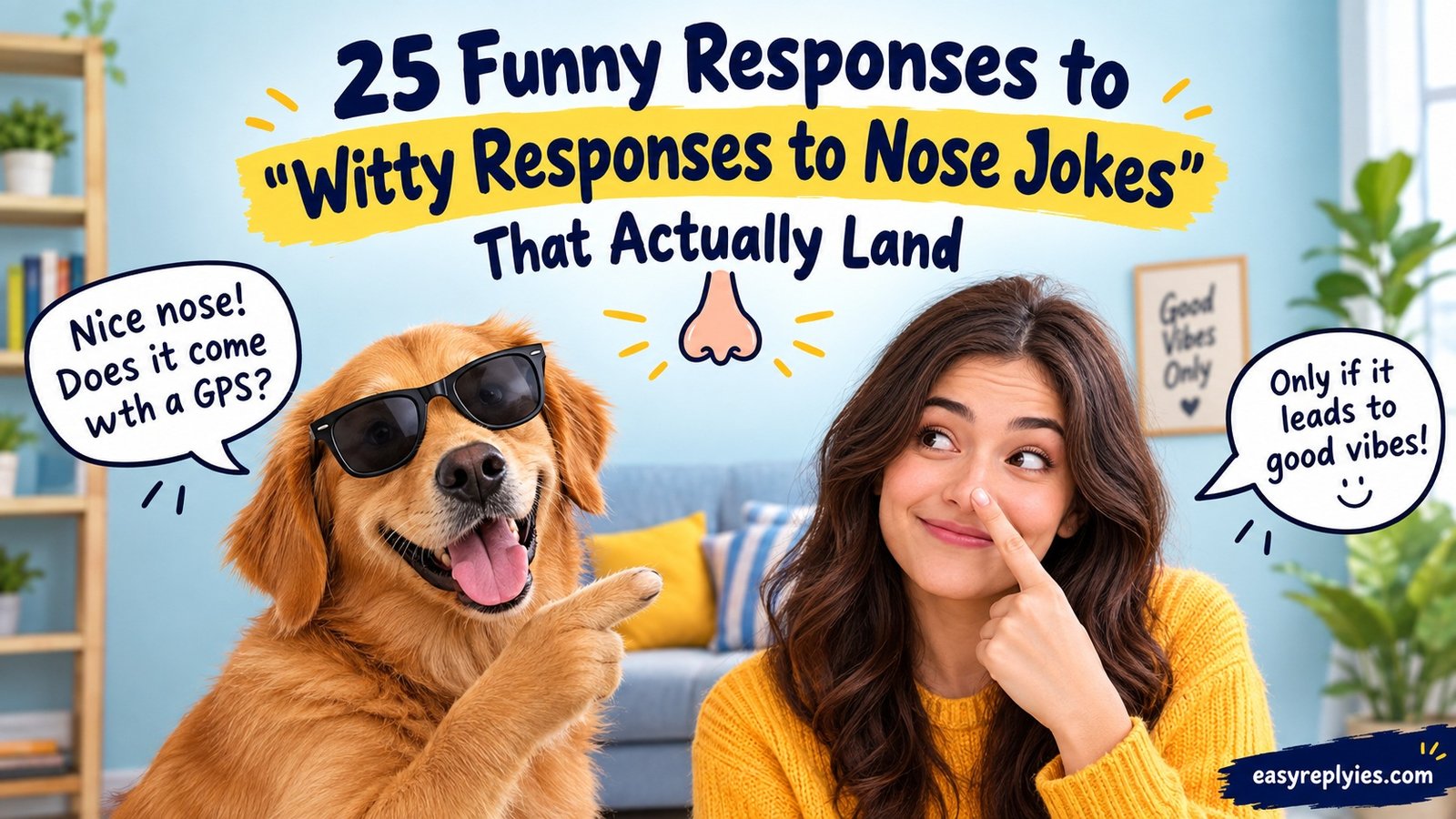
Funny Responses to “Witty Responses to Nose Jokes” That Actually Land work best when your response feels natural, quick, and confident rather than forced. When someone makes a joke about your nose, you can use humor, wit, and charm to keep the conversation light. A playful reply may suit a friend making a harmless tease, while a bold or classy answer can fit a rude, harsh, or genuinely rude remark. A smart comeback can change the moment, ease awkwardness, create laughter, and help you handle the situation. In my experience, the strongest lines are real-life-ready because they sound like something you would actually say.
For different situations, try witty responses, clever comebacks, playful replies, short text responses, sarcastic answers, or confident reactions. Even a simple “haha” can fit an intentionally silly joke, while a sharper answer can work during a quick battle of wit. You can turn the joke around, turn the tables, or use sarcasm without taking offense. The key is choosing a response based on how close you are to someone, the original comment, and whether the exchange feels uncomfortable. Good replies do not always need to win or shut down another person. Sometimes they simply show that you can joke around without escalating.
People who search for best comebacks or 25 Best Comebacks When Someone Makes Fun Of Your Nose often want an arsenal of lines for real-life moments. A great reply should sound casually delivered instead of copied from an article or guide. You can explore witty replies, humorous comebacks, clever retorts, playful banter, and verbal humor while remembering that a facial feature or personal appearance does not need defending. Everyone appreciates a good laugh, but a joke at your expense can make your reaction important. Use humorous, funny, smart, or classy lines to navigate teasing moments gracefully, keep attention on the joke itself, and avoid unnecessary offense. This also supports better social interaction, handling teasing, and stronger humor skills without being rude or causing extra escalation.
Funny Comebacks for Nose Jokes
A good nose-joke comeback doesn’t need to be complicated. The funniest replies often work because they acknowledge the joke, add an unexpected twist, and move the conversation along. These are best when the other person is clearly joking and you already have a comfortable relationship.
1. “I’d explain the joke, but I don’t want to air out your business.”
Meaning: You turn the joke back on them with a playful wordplay response.
Tone: Funny, clever, playful.
Example:
Friend: That nose joke was pretty obvious.
You: I’d explain the joke, but I don’t want to air out your business.
Best Use: Friends, casual conversations, and playful texting
2. “Careful, that joke is getting too close to my personal space.”
Meaning: You pretend the joke itself is invading your space.
Tone: Lighthearted, witty, casual.
Example:
Friend: I was just making a joke about your nose.
You: Careful, that joke is getting too close to my personal space.
Best Use: Friendly teasing where nobody is taking the comment seriously.
3. “I nose what you did there.”
Meaning: A simple pun turns the familiar phrase “I know” into a nose-related joke.
Tone: Silly, playful, goofy.
Example:
Friend: Did you catch that pun?
You: I nose what you did there.
Best Use: Texting, group chats, or quick playful exchanges.
Clever Replies That Turn the Joke Around
Sometimes the easiest way to handle teasing is to redirect it. Instead of defending yourself, make the other person part of the joke. That keeps the exchange playful while showing that you can take a joke without becoming the target.
4. “That’s a bold statement coming from someone whose jokes need directions.”
Meaning: You suggest their joke is so weak that even it needs help finding its way.
Tone: Clever, confident, mildly sarcastic.
Example:
Friend: Got another nose joke for you.
You: That’s a bold statement coming from someone whose jokes need directions.
Best Use: Friendly banter with someone who enjoys competitive joking.
5. “You really picked my nose as your favorite topic?”
Meaning: You humorously point out how oddly committed they are to the subject.
Tone: Funny, teasing, confident.
Example:
Friend: I’ve got another nose joke.
You: You really picked my nose as your favorite topic?
Best Use: Repeated teasing among friends.
6. “At least my nose is getting more attention than your punchlines.”
Meaning: You shift the joke toward the quality of their humor.
Tone: Confident, sarcastic, playful.
Example:
Friend: Your nose is basically the star of this conversation.
You: At least my nose is getting more attention than your punchlines.
Best Use: Casual banter when the other person can handle a stronger comeback.
Short Nose-Joke Responses for Texting
Text conversations move quickly, so a long comeback can feel forced. A short response works better when you want to acknowledge the joke without turning it into a whole conversation.
7. “Nosey, aren’t we?”
Meaning: A familiar phrase becomes a quick nose-related tease.
Tone: Short, playful, casual.
Example:
Friend: Why are you defending your nose so much?
You: Nosey, aren’t we?
Best Use: Texts, DMs, and quick replies.
8. “That joke had no nose for subtlety.”
Meaning: You jokingly criticize how obvious the joke was.
Tone: Witty, silly, light.
Example:
Friend: I think I made a pretty subtle nose joke.
You: That joke had no nose for subtlety.
Best Use: Texting and social media comments.
9. “I smell a weak comeback.”
Meaning: You use “smell” as a playful extension of the nose theme.
Tone: Funny, confident, cheeky.
Example:
Friend: You can’t beat my nose jokes.
You: I smell a weak comeback already.
Best Use: Friendly competitions and group chats.
Playful Replies for Close Friends
With close friends, you usually have more room to be ridiculous. In this setting, an intentionally corny response can actually be funnier than a sharp insult because everyone understands that you’re playing along.
10. “My nose called. It wants better material.”
Meaning: You personify your nose and blame it for rejecting the joke.
Tone: Goofy, playful, harmless.
Example:
Friend: Your nose is becoming a regular character in my jokes.
You: My nose called. It wants better material.
Best Use: Close friends and relaxed conversations.
11. “Keep going. My nose loves the free publicity.”
Meaning: Instead of being bothered by the joke, you pretend you’re benefiting from the attention.
Tone: Confident, playful, humorous.
Example:
Friend: I can make nose jokes all day.
You: Keep going. My nose loves the free publicity.
Best Use: Friendly teasing when you want to show you’re completely unfazed.
12. “Honestly, my nose has more fans than you do.”
Meaning: You exaggerate your nose’s popularity for comic effect.
Tone: Silly, confident, teasing.
Example:
Friend: Nobody wants another nose joke.
You: Honestly, my nose has more fans than you do.
Best Use: Close friends who enjoy exaggerated humor.
Sarcastic Comebacks for a Stronger Exchange
Sarcasm can make a comeback sharper, but it also changes the mood. Use these when the conversation is clearly competitive and both people are comfortable trading jokes. If the person seems genuinely critical, a softer response is usually better.
13. “Wow, you really spent time developing that one.”
Meaning: You pretend their joke required an impressive amount of effort.
Tone: Dry, sarcastic, understated.
Example:
Friend: Did you see the joke I made about your nose?
You: Wow, you really spent time developing that one.
Best Use: Sarcastic banter with friends.
14. “Congratulations. Your nose joke has officially been heard.”
Meaning: You dramatically treat their joke like an announcement that has been formally received.
Tone: Dry, humorous, sarcastic.
Example:
Friend: I have another nose joke.
You: Congratulations. Your nose joke has officially been heard.
Best Use: Casual conversations where deadpan humor works.
Read More:25 Funny Responses to “What’s Shakin Bacon?” That Keep the Conversation Sizzling
15. “I’d laugh, but I’m trying to encourage quality control.”
Meaning: You jokingly suggest the punchline needs improvement.
Tone: Sarcastic, clever, confident.
Example:
Friend: That was hilarious, admit it.
You: I’d laugh, but I’m trying to encourage quality control.
Best Use: Friendly roast sessions.
Cute and Silly Nose Puns
Not every response needs to be a comeback. Sometimes joining the joke is the better move, particularly when you want to keep the conversation cheerful rather than competitive.
16. “Let’s not make a big nose out of this.”
Meaning: You twist “big deal” into a nose pun.
Tone: Silly, friendly, goofy.
Example:
Friend: We should probably stop with the nose jokes.
You: Agreed. Let’s not make a big nose out of this.
Best Use: Friends, family, and playful chats.
17. “I can handle it. I’ve got a nose for humor.”
Meaning: You claim that you naturally recognize funny situations.
Tone: Playful, confident, punny.
Example:
Friend: Think you can handle another joke?
You: I can handle it. I’ve got a nose for humor.
Best Use: Casual banter and text messages.
18. “That joke really knows how to sniff out an audience.”
Meaning: You extend the nose theme into an exaggerated pun.
Tone: Goofy, creative, playful.
Example:
Friend: Everyone laughed at that one.
You: That joke really knows how to sniff out an audience.
Best Use: Group chats and deliberately corny humor.
Confident Responses When Someone Keeps Teasing You
Repeated jokes can become annoying, even when they started harmlessly. A confident response can acknowledge the humor while making it clear that you’ve had enough.
19. “You’ve made your point. My nose isn’t going anywhere.”
Meaning: You calmly shut down repeated teasing without becoming hostile.
Tone: Confident, direct, composed.
Example:
Friend: Another nose joke!
You: You’ve made your point. My nose isn’t going anywhere.
Best Use: When teasing has gone on a little too long.
20. “You can keep joking, but at least try something original.”
Meaning: You challenge the person to come up with fresh material.
Tone: Direct, confident, mildly teasing.
Example:
Friend: I’ve got the same nose joke again.
You: You can keep joking, but at least try something original.
Best Use: Friendly situations where you want to push back without escalating.
Polite Responses When You Don’t Want to Roast Back
Not every situation calls for a clever comeback. If you’re unsure whether someone is joking or you’re simply not interested in appearance-based teasing, a calm response can work better than trying to out-joke them.
21. “Haha, I’ll let that one slide.”
Meaning: You acknowledge the joke while subtly signaling that you don’t want more.
Tone: Friendly, restrained, polite.
Example:
Coworker: Sorry, I couldn’t resist the nose joke.
You: Haha, I’ll let that one slide.
Best Use: Casual workplace interactions or situations where you want to stay friendly.
22. “I know you’re joking, but let’s pick a different topic.”
Meaning: You clearly communicate a boundary without insulting the other person.
Tone: Respectful, direct, mature.
Example:
Person: Come on, it was only a joke about your nose.
You: I know you’re joking, but let’s pick a different topic.
Best Use: When teasing is becoming uncomfortable or repetitive.
Funny Replies for Social Media Comments
Public comments benefit from responses that are brief and easy for other people to understand. A playful reply can keep the interaction entertaining without turning the comment section into an argument.
23. “My nose has entered the chat.”
Meaning: You humorously treat your nose as another participant in the conversation.
Tone: Casual, funny, internet-friendly.
Example:
Comment: We need to talk about that nose.
You: My nose has entered the chat.
Best Use: Social media comments, group chats, and casual online conversations.
24. “The nose has been summoned.”
Meaning: You dramatically pretend the conversation has officially called your nose into action.
Tone: Playful, dramatic, silly.
Example:
Comment: Someone made another nose joke.
You: The nose has been summoned.
Best Use: Social media and meme-style conversations.
The Best All-Purpose Response
When you don’t know exactly what tone to use, choose something that is funny without being overly aggressive. The safest comeback is usually one that makes fun of the situation rather than attacking the other person’s appearance or personality.
25. “Well, at least you’re having fun with it.”
Meaning: You acknowledge the joke while showing that you’re not bothered by it.
Tone: Relaxed, confident, friendly.
Example:
Friend: Sorry, I couldn’t resist making another nose joke.
You: Well, at least you’re having fun with it.
Best Use: Friends, casual conversations, and situations where you want to keep things light.
How to Choose the Right Nose-Joke Response
The funniest comeback isn’t necessarily the sharpest one. Context matters more than cleverness because the same sentence can sound playful between friends and rude when said to a stranger. Start by judging the other person’s intention: are they teasing you affectionately, trying to embarrass you, or simply making a silly pun?
For casual banter, a goofy nose pun is usually enough. If someone keeps repeating the joke, a confident response can redirect the conversation. And if the comment genuinely bothers you, don’t feel obligated to produce a clever comeback at all—a straightforward boundary is often the better answer.
When a Funny Comeback Works Best
A humorous response is most effective when everyone involved understands that the exchange is playful. Friends, siblings, group chats, and relaxed social situations generally give you more freedom to experiment with sarcasm and wordplay.
Watch the other person’s reaction, too. If they laugh and continue the banter, you’re probably matching the mood. If they become defensive or the conversation gets uncomfortable, switch to a calmer response. Good humor should keep the conversation enjoyable, not turn a harmless joke into a personal argument.
When to Avoid a Sharp Comeback
There are moments when responding with an even stronger joke isn’t worth it. If someone is clearly trying to embarrass you, repeatedly comments on your appearance, or ignores your request to stop, a witty response may accidentally encourage them to continue.
In those cases, something simple such as “I’m not really into jokes about my appearance” can be more effective. You don’t need to win every exchange. Sometimes the most confident response is refusing to participate in a conversation that isn’t respectful.
Tips for Making Your Own Nose-Joke Comebacks
You don’t have to memorize a list of replies. You can create better responses on the spot by playing with familiar words connected to the topic—nose, smell, sniff, scent, air, breathe, face, and obvious are all useful starting points.
Another easy technique is to exaggerate the situation. Pretend your nose is famous, offended, demanding better material, or somehow running the conversation. That creates absurdity without requiring a personal insult. Keep the sentence short, especially in texting, because a punchline usually works better when it doesn’t need an explanation.
Funny Responses vs. Mean Comebacks
There’s a useful distinction between playful teasing and personal insults. A funny response usually makes the situation ridiculous; a mean comeback tries to make the other person feel bad. If you’re unsure which direction to take, make the joke about the conversation rather than the person’s appearance, intelligence, or insecurities.
For example, joking that your nose has “entered the chat” is harmless. Attacking someone else’s appearance in return may escalate the exchange. The goal is to sound quick-witted without creating unnecessary tension.
Using These Replies Over Text
Text removes facial expressions and vocal tone, so sarcasm can be harder to interpret. A line that sounds hilarious when spoken with a smile might look genuinely hostile on a screen.
For texting, favor short, obviously playful responses. Emojis can occasionally help signal intent, but you shouldn’t need several of them to make a joke understandable. If the relationship is casual, a silly pun is often safer than a cutting sarcastic comeback.
Frequently Asked Questions
What is the best way to respond to a nose joke?
The best response depends on the relationship and tone. For friendly teasing, try a playful pun or light comeback. If the comment feels disrespectful, a calm boundary-setting response is usually more appropriate.
What is a funny response to a nose joke?
A simple option is, “I nose what you did there.” It works because it immediately turns the original joke into another joke without making the exchange too serious.
Should I keep my nose-joke reply short?
Usually, yes. Short responses are easier to deliver naturally and tend to work particularly well in texting or fast-moving conversations.
How can I respond without sounding rude?
Focus your humor on the situation instead of attacking the other person’s appearance or personality. Self-aware, absurd, and pun-based replies are generally easier to keep light.
What if someone keeps making nose jokes about me?
If the teasing becomes repetitive or uncomfortable, you don’t have to keep joking back. Try saying, “I know you’re joking, but let’s talk about something else.” A clear response can establish a boundary without starting an argument.
Can these responses be used in professional conversations?
Only some of them. A mild, friendly response may work among coworkers who already have that kind of relationship, but sarcastic or appearance-focused jokes can easily be misunderstood at work. When in doubt, keep it neutral.
Conclusion
The best funny responses to “witty responses to nose jokes” aren’t necessarily the most complicated—they’re the ones that fit the moment. A goofy pun can keep friendly teasing fun, a clever comeback can turn the joke around, and a straightforward response can help when someone has crossed a line. Before choosing your reply, consider your relationship with the person, the setting, and whether the original comment was genuinely playful. Match the energy without losing your own personality, and don’t be afraid to skip the comeback entirely when a respectful boundary makes more sense.







1 thought on “25 Funny Responses to “Witty Responses to Nose Jokes” That Actually Land”