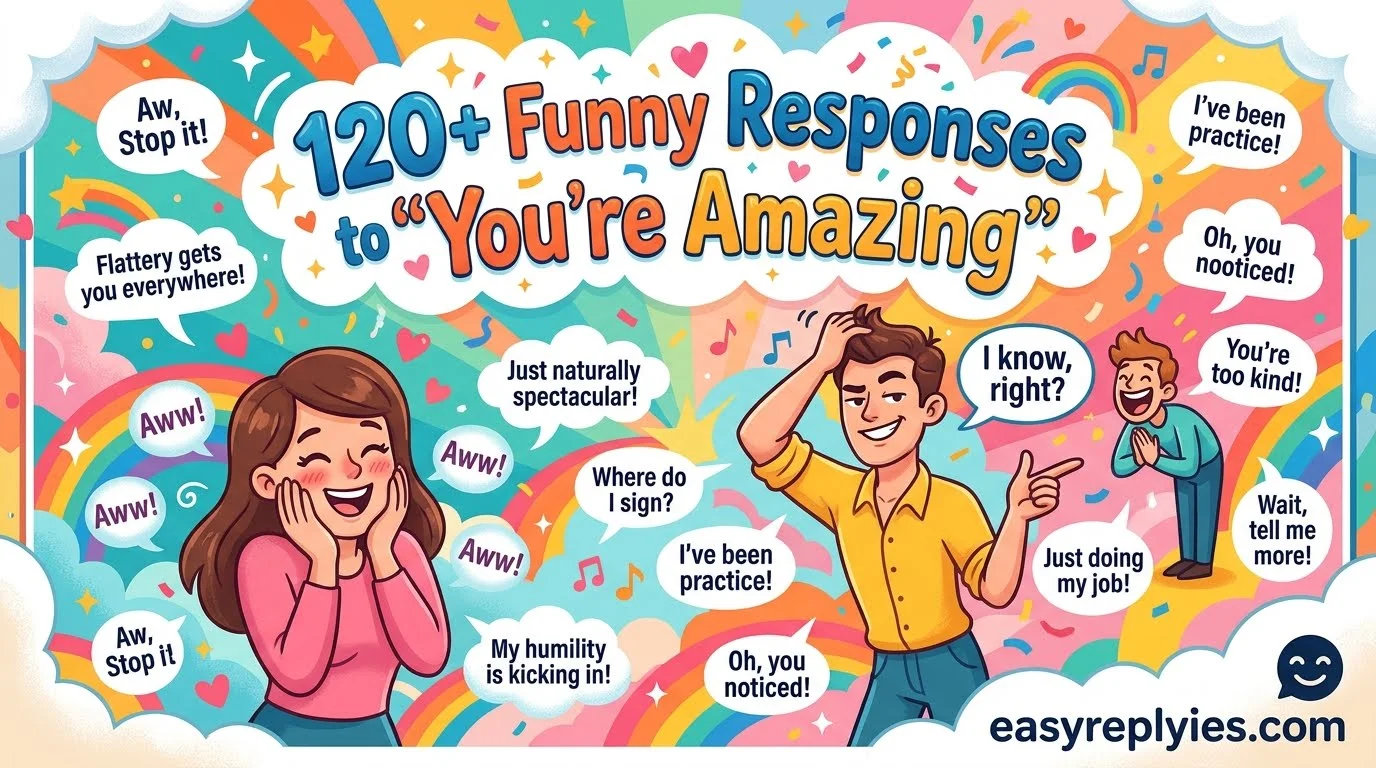
Funny Responses to “You’re Amazing” turn unexpected compliments into playful moments, helping you reply with confidence, humor, and charm.
We’ve all been there: you’re minding your own business when a guy suddenly sends a flirty comment, a cheeky text, or a smooth pickup line, leaving you wondering what to say next. Whether the compliment is sweet, awkward, or unexpected, the right response can turn an ordinary moment into a memorable conversation. You don’t need to be a comedian or dating expert to come up with the best comebacks. A little humor, confidence, and self-expression can help you deliver a clever response that feels natural, fun, and easy to use in real life. If you’re interested in him or simply want to keep things playful, a smart reply can make all the difference.
From 44+ epic replies to witty comebacks, playful replies, and charming comments, there are plenty of ways to handle flirting, dating, and everyday social interaction. Try clever comebacks, funny remarks, quick replies, or cheeky messages when someone uses pickup lines or tries a little smooth talk. In my experience, good flirting techniques and dating advice aren’t about memorizing perfect lines; they’re about understanding the context, situation, and mood. Strong conversational skills and social skills make it easier to respond to unexpected compliments, show positive reactions, and handle compliments without making things uncomfortable. Whether you’re responding to flirty comments during romantic conversations or using humorous reactions to encourage playful banter, aim for witty responses, confident communication, and lighthearted conversation that feels genuine.
1. “I Know, My Mom Says It Too.”
This is an easygoing way to accept the compliment while pretending that your amazingness is already well-established. It works particularly well when the other person is being genuinely complimentary but the conversation has a relaxed, joking tone.
Meaning
You’re accepting the compliment while adding a little self-aware humor. The joke is that you supposedly have an established reputation for being amazing.
Tone
Funny, confident, casual, and slightly cheeky.
Example
Friend: You’re amazing for helping me with that.
You: I know, my mom says it too.
Best Use
Use this with friends, siblings, or someone you already joke around with. It can sound a little cocky with someone you barely know, so context matters.
2. “Please, I Have a Reputation to Maintain.”
This response turns the compliment into a playful exaggeration. It suggests that being amazing is not a surprise but part of your carefully maintained public image.
Meaning
You’re jokingly acting as though being amazing is a responsibility you take very seriously.
Tone
Playful, confident, humorous, and slightly dramatic.
Example
Coworker: Thanks for fixing that so quickly. You’re amazing.
You: Please, I have a reputation to maintain.
Best Use
It works nicely in casual work conversations, group chats, or conversations with friends where a little theatrical humor feels natural.
3. “Finally, Someone Noticed.”
Sometimes the funniest response is to act as though everyone else has been completely blind to your greatness.
Meaning
You’re pretending that being amazing has been obvious all along and the other person is simply late to the realization.
Tone
Sarcastic, confident, and playful.
Example
Friend: Honestly, you’re amazing.
You: Finally, someone noticed.
Best Use
This is best with people who understand your sense of humor. Avoid it when the compliment is serious or emotionally meaningful, because sarcasm can make a sincere moment feel dismissed.
4. “I’ll Be Adding This to My Resume.”
A compliment becomes funnier when you treat it like a professional achievement.
Meaning
You’re joking that “You’re amazing” is such an impressive endorsement that it deserves to become an official qualification.
Tone
Funny, clever, lighthearted, and confident.
Example
Friend: You actually remembered my birthday. You’re amazing.
You: Thanks. I’ll be adding this to my resume.
Best Use
Great for texting, social media conversations, coworkers you know well, and friends.
5. “Careful, My Ego Has Wi-Fi.”
This one exaggerates the effect of compliments in a silly way.
Meaning
You’re joking that another compliment might cause your ego to connect, grow, and take over.
Tone
Silly, modern, playful, and self-aware.
Example
Friend: You’re amazing at this.
You: Careful, my ego has Wi-Fi.
Best Use
Use it in casual texts and group chats. It works especially well when the conversation already has a joking rhythm.
6. “That’s Going Straight to My Head.”
This classic-style reply is simple because it acknowledges that compliments feel good without taking yourself too seriously.
Meaning
You’re playfully admitting that the compliment might make you a little too confident.
Tone
Friendly, humorous, modest, and relaxed.
Example
Them: You’re amazing.
You: That’s going straight to my head. Keep talking.
Best Use
A good choice when you want something funny but not overly sarcastic. It can work with friends, dates, family, or casual acquaintances.
7. “I Accept Compliments in Cash Too.”
If you want to make the exchange more ridiculous, turn the compliment into a fake payment arrangement.
Meaning
You’re pretending that compliments are a form of currency and jokingly asking for more.
Tone
Playful, cheeky, and absurd.
Example
Friend: You’re amazing for doing that.
You: Thank you. I accept compliments in cash too.
Best Use
This is ideal for friends and casual texting. The joke is intentionally exaggerated, so it works best when the conversation is already informal.
8. “Don’t Stop, I’m Taking Notes.”
This response keeps the compliment going while making fun of your own enjoyment of it.
Meaning
You’re pretending to collect compliments as though they’re valuable information.
Tone
Funny, confident, teasing, and playful.
Example
Them: You’re amazing.
You: Don’t stop. I’m taking notes.
Best Use
Works particularly well over text and with someone who enjoys banter.
9. “You’re Making It Really Hard to Stay Humble.”
This is a playful way to acknowledge the compliment without sounding completely serious.
Meaning
You’re joking that the other person’s praise is making humility increasingly difficult.
Tone
Confident, funny, warm, and slightly cheeky.
Example
Friend: You always know how to make everyone laugh. You’re amazing.
You: You’re making it really hard to stay humble.
Best Use
Good for friends, family, and casual conversations. It can also work in a light workplace exchange if the relationship is informal.
10. “I’m Framing This Message.”
Sometimes the best response is to pretend the compliment is an important historical document.
Meaning
You’re joking that their compliment is so valuable that you intend to preserve it forever.
Tone
Cute, funny, appreciative, and playful.
Example
Them: You’re amazing. Seriously.
You: I’m framing this message.
Best Use
This is especially good for texting because it shows that you appreciated the compliment while keeping the mood light.
11. “Please Repeat That, My Wi-Fi Cut Out.”
This response jokingly asks the person to compliment you again.
Meaning
You heard them perfectly well, but you’re pretending you missed it because you want another compliment.
Tone
Teasing, cheeky, funny, and playful.
Example
Them: You’re amazing.
You: Sorry, my Wi-Fi cut out. Can you say that again?
Best Use
Excellent for text conversations, especially with friends or someone you have playful chemistry with.
12. “That’s Exactly What My Secret Fan Club Says.”
Turn the compliment into evidence of an imaginary fan club.
Meaning
You’re joking that the other person is simply joining a supposedly large group of people who already admire you.
Tone
Funny, confident, ridiculous, and teasing.
Example
Friend: You’re amazing.
You: Thanks. That’s exactly what my secret fan club says.
Best Use
Best among friends or people who enjoy exaggerated humor. It may be too silly for formal conversations.
13. “I Was Going for ‘Legendary,’ But Amazing Will Do.”
This reply takes confidence to an intentionally ridiculous level.
Meaning
You’re pretending that “amazing” is actually below the compliment you expected.
Tone
Bold, sarcastic, humorous, and exaggerated.
Example
Friend: You’re amazing for pulling that off.
You: I was going for “legendary,” but amazing will do.
Best Use
Use this with close friends or in a joking group chat. Because it sounds deliberately arrogant, it depends heavily on the relationship.
14. “Aw, Are You Trying to Make Me Blush?”
When you want something funny with a warmer edge, this response acknowledges the compliment while inviting more playful conversation.
Meaning
You’re pretending that the compliment has embarrassed you in a cute way.
Tone
Playful, warm, slightly flirty, and light.
Example
Them: You’re amazing.
You: Aw, are you trying to make me blush?
Best Use
This fits well when there is some flirtation or affectionate teasing. With a friend, it can also simply sound playful.
15. “You’re Not So Bad Yourself.”
A compliment can become a back-and-forth exchange instead of ending after “thank you.”
Meaning
You’re returning the positive energy without making the response overly sentimental.
Tone
Friendly, warm, playful, and modest.
Example
Them: You’re amazing.
You: You’re not so bad yourself.
Best Use
A versatile option for friends, dates, family members, or casual conversations. It is especially useful when you want to return the compliment naturally.
16. “I’ll Try to Stay Grounded After This.”
This is a softer joke for people who want to sound appreciative rather than overly cocky.
Meaning
You’re joking that such a nice compliment might make you feel a little too proud.
Tone
Humble, funny, warm, and relaxed.
Example
Friend: You really helped me today. You’re amazing.
You: Thanks. I’ll try to stay grounded after this.
Best Use
Good when someone gives you a sincere compliment and you want to respond with humor without making fun of their kindness.
17. “Plot Twist: I’m Just Really Good at Pretending.”
For a more self-deprecating style, this reply turns the compliment into a joke about secretly having no idea what you’re doing.
Meaning
You’re playfully downplaying your ability by pretending your success is an elaborate performance.
Tone
Self-deprecating, funny, casual, and modest.
Example
Friend: How did you solve that so quickly? You’re amazing.
You: Plot twist: I’m just really good at pretending.
Best Use
Great among friends and coworkers you know well. It can make a confident compliment feel less serious and more conversational.
18. “I’d Say You’re Amazing Too, But I Don’t Want Us Getting Emotional.”
This works when both people are comfortable with affectionate teasing.
Meaning
You’re returning the compliment while jokingly pretending that sincerity would become too emotional.
Tone
Funny, affectionate, teasing, and warm.
Example
Friend: You’re amazing, seriously.
You: I’d say you’re amazing too, but I don’t want us getting emotional.
Best Use
Best for close friends, siblings, or people with whom affectionate sarcasm is normal.
19. “Thank You. I Practiced.”
This is short, unexpected, and funny because it treats being amazing like a skill you deliberately trained for.
Meaning
You’re pretending that your impressive behavior came from years of practice.
Tone
Dry, clever, confident, and playful.
Example
Them: You’re amazing.
You: Thank you. I practiced.
Best Use
This is particularly effective in text messages because its short delivery makes the punchline land quickly.
20. “That’s a Lot of Pressure for Tomorrow.”
Here, you turn the compliment into an imaginary obligation to remain amazing.
Meaning
You’re joking that if you’re amazing today, everyone will expect the same performance tomorrow.
Tone
Witty, casual, understated, and funny.
Example
Friend: You’re amazing for doing all that.
You: Thanks. That’s a lot of pressure for tomorrow.
Best Use
Useful when you want a clever response without sounding too cocky or flirty.
21. “Amazing? I Was Aiming for Unreasonably Impressive.”
This deliberately raises the bar to create a confident joke.
Meaning
You’re pretending that “amazing” is merely an acceptable result when you were aiming for something even more dramatic.
Tone
Confident, sarcastic, playful, and exaggerated.
Example
Friend: You’re amazing.
You: Amazing? I was aiming for unreasonably impressive.
Best Use
Best for friends, playful coworkers, and people who appreciate dry humor.
22. “Keep Talking. This Is Great for My Self-Esteem.”
This is a humorous way to encourage someone not to stop complimenting you.
Meaning
You’re acknowledging that their praise feels good while pretending to need a steady supply of compliments.
Tone
Funny, self-aware, cheeky, and casual.
Example
Them: You’re amazing.
You: Keep talking. This is great for my self-esteem.
Best Use
Ideal for casual texting, close friends, and playful conversations.
23. “Well, This Is Going to Be My Personality for the Week.”
This one works by exaggerating how much you intend to enjoy the compliment.
Meaning
You’re joking that one compliment is enough to fuel your confidence for several days.
Tone
Funny, relatable, casual, and self-aware.
Example
Friend: You’re amazing for helping me.
You: Thanks. This is going to be my personality for the week.
Best Use
A strong choice for social media messages, group chats, and everyday conversations with friends.
24. “I’ll Pretend I’m Not Blushing.”
When the compliment is sweet and you want to keep the response cute rather than sarcastic, this is an easy option.
Meaning
You’re showing that the compliment affected you while keeping the moment playful.
Tone
Cute, warm, slightly flirty, and friendly.
Example
Them: You’re honestly amazing.
You: I’ll pretend I’m not blushing right now.
Best Use
This works especially well in texting and dating conversations, although it can also be used jokingly with close friends.
25. “Thank You. Please Allow Three to Five Business Days for My Ego to Recover.”
This is a deliberately overcomplicated way of saying that the compliment has gone straight to your ego.
Meaning
You’re joking that you need time to process such a generous compliment.
Tone
Absurd, clever, playful, and sarcastic.
Example
Friend: You’re amazing. I don’t know what I’d do without you.
You: Thank you. Please allow three to five business days for my ego to recover.
Best Use
Excellent for texting, group chats, and social conversations where exaggerated humor is welcome.How to Choose the Right Funny Response
Not every funny response to “You’re amazing” creates the same impression. The safest approach is to match your reply to the relationship and the emotional weight of the compliment.
If someone casually praises you for helping with something, a confident joke like “I’ll be adding this to my resume” keeps things light. If someone gives you a heartfelt compliment, a warmer response such as “I’ll pretend I’m not blushing” acknowledges the kindness instead of making the moment entirely about the joke.
Texting also requires a little extra care. Without facial expressions or vocal tone, sarcasm can sound more serious than intended. If there is any doubt, choose playful humor over cutting sarcasm.
Quick tip: The funnier response usually isn’t the most complicated one. A short line delivered at the right moment often feels more natural than a carefully constructed joke.
Funny Replies for a Close Friend
Close friendships give you more freedom to be ridiculous because the other person is more likely to understand your humor.
Meaning
The goal is to keep the friendship’s usual banter going rather than turning the compliment into a formal thank-you.
Tone
Playful, sarcastic, silly, and relaxed.
Example
Friend: You’re amazing for coming through at the last minute.
You: I know. Please try to contain your admiration.
Best Use
Use exaggerated confidence with friends who already tease you. If your friend is being unusually sincere, however, consider following the joke with a genuine “Seriously, thank you.”
Funny Responses to “You’re Amazing” Over Text
Text messages are perfect for short punchlines because the reader has to imagine your delivery.
Meaning
A text-friendly response should be quick enough to read instantly and clear enough that the joke doesn’t require a long explanation.
Tone
Casual, witty, playful, or mildly sarcastic.
Example
Them: You’re amazing 😂
You: I accept compliments in screenshot form.
Best Use
Use short responses when the original message is short. If they sent a heartfelt paragraph, replying with only a joke can seem dismissive.
Read More:120 Funny Responses to “What’s Your Superpower?”
Playful Replies When You Want to Return the Compliment
Sometimes “You’re amazing” is an invitation to exchange appreciation rather than simply accept praise.
Meaning
Returning the compliment keeps the conversation balanced and shows that you value the other person too.
Tone
Warm, friendly, affectionate, and playful.
Example
Them: You’re amazing.
You: Says the person who makes being around them ridiculously easy.
Best Use
This works well with close friends, romantic interests, family members, or anyone who has just done something kind for you.
Flirty Responses to “You’re Amazing”
A compliment can occasionally have romantic or flirtatious energy, especially when it comes from someone you’re dating or someone you’re getting to know.
Meaning
A flirty reply acknowledges the compliment while giving the other person an opening to continue the chemistry.
Tone
Playful, warm, teasing, and lightly romantic.
Example
Them: You’re amazing.
You: Careful. Keep talking like that and I might start liking you.
Best Use
Only use a flirty response when the relationship already supports that tone. A romantic joke can feel uncomfortable if the other person intended nothing more than friendly appreciation.
Short and Funny Replies
Not every compliment needs a paragraph. In casual conversations, a two- or three-word answer can be funnier because of its timing.
Meaning
These replies keep the exchange moving without overthinking the compliment.
Tone
Dry, confident, casual, and playful.
Example
Them: You’re amazing.
You: Obviously. 😂
Them: You’re amazing!
You: I’ve heard rumors.
Best Use
Short replies are especially useful for texting, group chats, Instagram messages, and quick conversations.
Clever Responses Without Being Rude
If you enjoy sarcasm but don’t want to sound arrogant, choose a response that makes fun of yourself rather than the person complimenting you.
Meaning
Self-aware humor lets you accept praise while signaling that you’re not taking yourself too seriously.
Tone
Clever, friendly, modest, and humorous.
Example
Them: You’re amazing at explaining things.
You: Thank you. Years of confusing myself prepared me for this moment.
Best Use
This approach is useful when you’re not sure how much sarcasm the other person will appreciate.
Professional Responses to “You’re Amazing”
A workplace compliment deserves slightly more restraint. Humor is fine when the environment is casual, but the safest response still acknowledges the person’s appreciation.
Meaning
The aim is to remain personable without making the exchange overly personal or sarcastic.
Tone
Polite, appreciative, light, and professional.
Example
Coworker: You’re amazing for getting that finished before the deadline.
You: Thanks! I’ll happily add that to my imaginary employee-of-the-month award.
Best Use
Use mild humor with colleagues you know. In a formal email or with a manager you barely know, a simple “Thank you, I appreciate that” may be more appropriate.
When You Want to Sound Confident
There is nothing wrong with accepting a compliment confidently. Humor can make confidence feel relaxed rather than boastful.
Meaning
You’re comfortable receiving praise and aren’t pretending that you disagree with it.
Tone
Confident, playful, cheeky, and upbeat.
Example
Friend: You’re amazing.
You: I do have my moments.
Best Use
This is useful when you want to acknowledge the compliment without either rejecting it or going overboard.
When Someone Is Being Extra Generous With Compliments
If someone keeps praising you, you can turn the repetition itself into the joke.
Meaning
You’re acknowledging the compliment while playfully pointing out that they’re becoming unusually generous.
Tone
Teasing, appreciative, and humorous.
Example
Them: You’re amazing. Seriously, you’re the best.
You: At this point, I’m going to need a larger head.
Best Use
Use it when several compliments are arriving in a row. The exaggerated response makes the exchange feel playful rather than overly serious.
When You Want a Cute Instead of Sarcastic Response
Not every funny answer needs a punchline. Sometimes a little playful vulnerability feels more natural.
Meaning
You’re showing that you genuinely appreciate the compliment while keeping the mood light.
Tone
Cute, warm, appreciative, and slightly playful.
Example
Them: You’re amazing.
You: Stop, you’re making me smile like an idiot.
Best Use
This is especially suitable for someone you’re close to or someone you’re romantically interested in.
When You Don’t Want to Sound Full of Yourself
If you’re naturally modest, jokes about being the greatest person alive may feel unnatural coming from you.
Meaning
A self-deprecating response lets you accept the compliment while keeping your personality grounded.
Tone
Humble, funny, relaxed, and self-aware.
Example
Them: You’re amazing.
You: I’m choosing to believe you before you change your mind.
Best Use
This works well when you want humor without pretending to have enormous confidence.
When the Compliment Is Completely Unexpected
An unexpected compliment can leave you searching for words. You don’t need a perfectly crafted comeback.
Meaning
Acknowledging your surprise can itself become the response.
Tone
Natural, surprised, warm, and funny.
Example
Them: You’re amazing.
You: Well, that was unexpectedly nice. Give me a second to recover.
Best Use
Use this when the compliment catches you off guard or comes from someone who doesn’t normally express themselves that way.
When Someone Says “You’re Amazing” After You Helped Them
The context matters here because the compliment is probably connected to something specific you did.
Meaning
A good response can accept the appreciation without making the other person feel as though they owe you something.
Tone
Friendly, grateful, humorous, and reassuring.
Example
Friend: You’re amazing for helping me move.
You: No problem. I accept pizza as payment for my heroic services.
Best Use
Perfect for favors between friends and casual acts of kindness. It keeps the exchange warm while making it clear that you’re not expecting anything serious in return.
When You Want to Keep the Conversation Going
A response can do more than acknowledge the compliment—it can create another opening for conversation.
Meaning
Instead of ending with “thanks,” you give the other person something to react to.
Tone
Playful, conversational, and engaging.
Example
Them: You’re amazing.
You: I know, but now I’m curious—what exactly earned me that title?
Best Use
This is useful when you want to continue talking rather than let the conversation stop after the compliment.
When a Sarcastic Reply Is Better Than a Sweet One
Sarcasm can be hilarious among people who understand each other’s humor, but it should be used carefully.
Meaning
A sarcastic reply deliberately exaggerates confidence for comic effect.
Tone
Dry, teasing, confident, and humorous.
Example
Friend: You’re amazing.
You: Please update your records accordingly.
Best Use
Best for close friends and established banter. Avoid sarcastic replies when the speaker is being vulnerable, sincere, or emotionally serious.
How to Respond Without Overthinking It
The easiest way to answer “You’re amazing” is to first identify what the person is actually doing. Are they thanking you? Praising your personality? Flirting? Expressing affection? Reacting to something impressive you did?
Once you know that, the response becomes much easier.
For a casual compliment, humor works well:
“I’ll be adding this to my resume.”
For a sincere compliment:
“That actually means a lot. Thank you.”
For playful chemistry:
“Careful, I might start believing you.”
For a close friend:
“Finally, someone noticed.”
The key is matching their energy rather than forcing a joke. A naturally delivered simple response will almost always sound better than a clever line that doesn’t fit the conversation.
Frequently Asked Questions
What is a funny response to “You’re amazing”?
A funny response can playfully exaggerate your confidence, such as “Finally, someone noticed” or “I’ll be adding this to my resume.” Choose something that matches the relationship and mood.
How can I respond politely when someone says “You’re amazing”?
A simple “Thank you, I really appreciate that” is usually enough. If the conversation is casual, you can add light humor without making the compliment feel dismissed.
What is a funny response to “You’re amazing” over text?
Short jokes tend to work especially well over text. Try “Please repeat that, my Wi-Fi cut out” or “Keep talking. This is great for my self-esteem.”
Can I give a flirty response to “You’re amazing”?
Yes, if the conversation already has romantic or playful energy. Something like “Careful. Keep talking like that and I might start liking you” can keep the tone flirtatious without being overly serious.
Should I respond with a joke or just say thank you?
Consider how sincere the original compliment seems. If someone is genuinely expressing appreciation, start with gratitude. You can then add a joke if it fits. For example: “Thank you! I’ll try not to let it go to my head.”
How do I know which response fits the situation?
Think about three things: your relationship, their tone, and the reason for the compliment. A sarcastic line may be perfect for a close friend but inappropriate at work, while a warm or flirty response may fit a personal conversation better.
Conclusion
When someone says “You’re amazing,” you don’t need to produce a complicated comeback. The best response is usually the one that sounds like something you would naturally say. A funny line can make the moment more memorable, while a warm response can show that you genuinely appreciated the compliment. Pay attention to the relationship and the tone before choosing between sarcasm, confidence, affection, or simple humor. If you’re unsure, start with “thank you” and add a playful twist. That way, you accept the kindness without taking yourself—or the conversation—too seriously.




1 thought on “120 Funny Responses to “You’re Amazing””