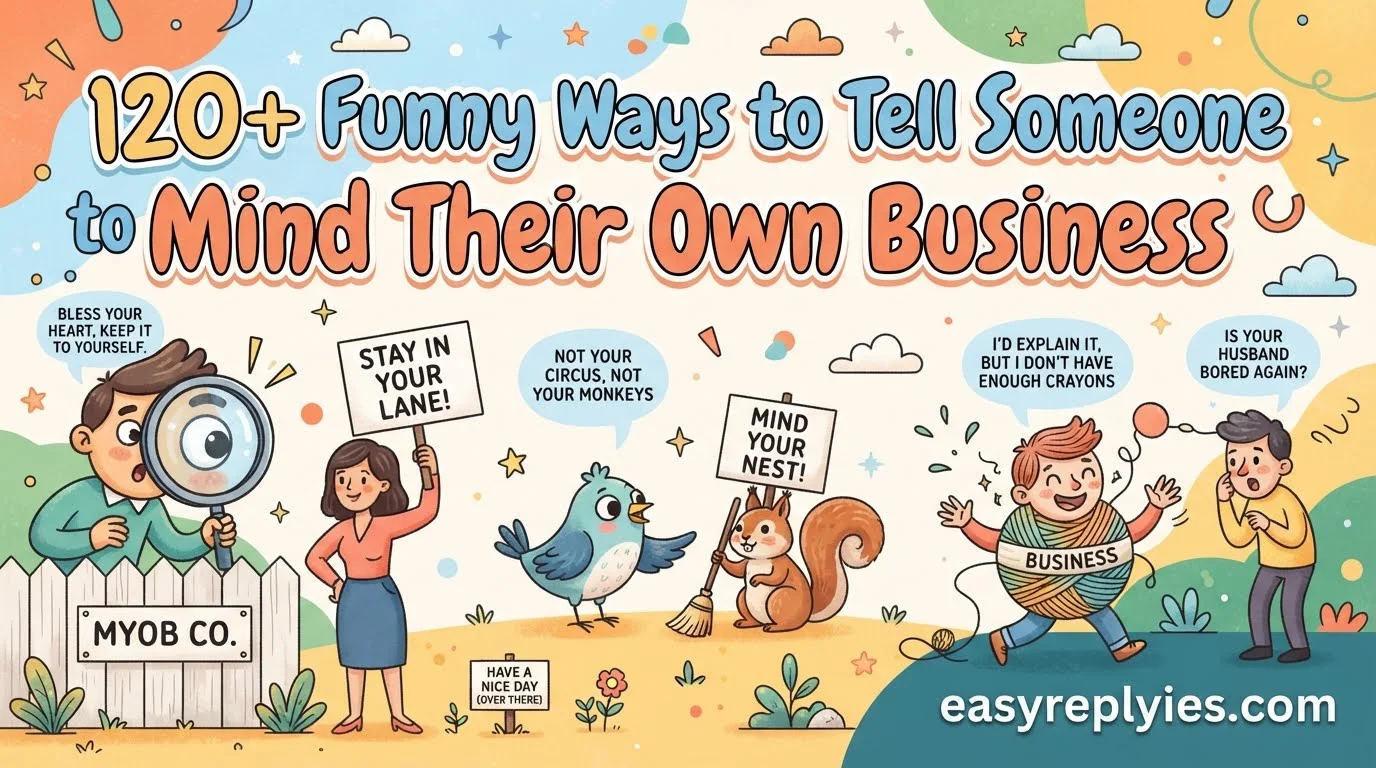
Funny Ways to Tell Someone to Mind Their Own Business help you handle nosy questions with humor, confidence, and respect without making the conversation unnecessarily tense.
Some people genuinely care, while others treat your private life as their favorite conversation topic. When a nosy person becomes too curious about your personal matters, choosing the right words can help you protect privacy without sounding angry or harsh. A little humor often works better than a blunt reply during casual conversations, family moments, and workplace chats. A good comeback can help you set a boundary, show confidence, and keep your message clear. For example, you could tell a curious friend, “My private life is a subscription service, and you haven’t paid!” This playful line can turn tension into laughter while keeping the situation light.
For friends and friendly social interactions, funny responses such as “Breaking news: My business is currently under investigation by absolutely nobody” can make awkward questions less uncomfortable. Another witty comeback is, “I’d tell you, but then I’d have to charge you for exclusive access.” These funny replies use sarcasm, playful humor, and clever lines to handle nosy comments without creating unnecessary conflict. However, always consider the other person’s feelings, emotional tone, and attitude before choosing your response. In a professional setting, with coworkers or acquaintances, a polished response is usually safer than a sharp joke. You might say, “That’s an interesting question, but let’s keep a little mystery alive.” Such respectful options maintain personal space, support effective communication, and help preserve relationships while making your boundaries clear.
The best response style depends on the person, the situation, and the type of question being asked. Harmless curiosity may deserve a playful line, while uncomfortable personal questions might require a calm, confident, and tactful response. In everyday interactions, a clear message delivered with respectful language can be more effective than an angry reaction. These examples show how each comeback can sound in an actual conversation, whether you need a memorable reply, a polite response, or a clever way to stop someone from prying. Good interpersonal communication involves situational awareness, understanding, and respect for social boundaries. With the right humor techniques and conversation skills, you can protect private matters, handle awkward moments, and maintain respectful boundaries without making anyone feel unnecessarily embarrassed.
1. “Did You Get a Subscription to My Personal Life?”
This response turns their curiosity into a joke. It is especially useful when someone keeps asking questions about something that really has nothing to do with them.
Meaning
You are jokingly pointing out that they seem unusually invested in your private affairs.
Tone
Funny, playful, sarcastic.
Example
Friend: So, how much did you spend on that?
You: Did you get a subscription to my personal life?
Friend: Fair point. I’ll cancel it.
Best Use
Use this with friends, siblings, or people who understand your humor. It can sound too sarcastic with someone who is already annoyed with you.
2. “That Information Is Above Your Pay Grade.”
This line borrows workplace language and applies it to a personal question, which is what makes it funny.
Meaning
You are saying that the person is not entitled to know the information.
Tone
Clever, confident, humorous.
Example
Coworker: So, are you planning to quit your job?
You: That information is above your pay grade.
Coworker: I guess I’ll wait for the official announcement.
Best Use
Works well in casual workplace conversations or with colleagues who enjoy dry humor. Avoid it if the situation is genuinely sensitive.
3. “I’d Tell You, but Then We’d Both Have to Pretend You’re Important.”
This is a sharper comeback that deliberately exaggerates the situation.
Meaning
You are joking that their involvement is not important enough to justify an answer.
Tone
Sarcastic, bold, teasing.
Example
Friend: Who were you texting last night?
You: I’d tell you, but then we’d both have to pretend you’re important.
Friend: Wow. Okay, I deserved that.
Best Use
Best reserved for close friends or people who can appreciate a strong joke. It may sound insulting if used with someone you barely know.
4. “That’s Classified Information.”
Sometimes you do not need a complicated comeback. A short answer delivered confidently can be much funnier.
Meaning
You are playfully treating an ordinary personal detail like a government secret.
Tone
Light, funny, casual.
Example
Friend: Where are you going tonight?
You: That’s classified information.
Friend: Should I be worried?
You: Only if you’re planning to investigate.
Best Use
Great for texting, casual conversations, and harmless questions from curious friends.
5. “My Privacy Department Has Declined Your Request.”
This response makes your boundary sound like an official corporate decision.
Meaning
You are saying no without directly saying “stop asking.”
Tone
Witty, playful, professional-sounding.
Example
Relative: So, when are you getting married?
You: My privacy department has declined your request.
Relative: Who exactly is your privacy department?
You: Me. I’m a very strict department.
Best Use
Particularly useful for repetitive personal questions at family gatherings.
6. “I’m Keeping That Between Me, Myself, and I.”
This is a softer alternative when you want privacy without sounding hostile.
Meaning
The information is personal, and you have decided not to share it.
Tone
Friendly, humorous, relaxed.
Example
Friend: Did you actually get the job?
You: I’m keeping that between me, myself, and I for now.
Friend: Fair enough.
Best Use
Good for friends, acquaintances, and casual conversations where you want to maintain a friendly atmosphere.
7. “Nice Try, Detective.”
When someone is asking question after question, you can turn the conversation into a pretend investigation.
Meaning
You are playfully calling them out for investigating your business.
Tone
Funny, teasing, sarcastic.
Example
Friend: Where were you yesterday? And who were you with?
You: Nice try, Detective.
Friend: I was just asking!
You: Your investigation says otherwise.
Best Use
Excellent for playful conversations with friends.
8. “I Didn’t Realize We Were Taking Questions Today.”
This one works especially well when someone suddenly starts interrogating you.
Meaning
You are humorously rejecting the idea that you owe them an explanation.
Tone
Dry, confident, witty.
Example
Coworker: Why did you leave early yesterday?
You: I didn’t realize we were taking questions today.
Coworker: Okay, okay. I’ll stop.
Best Use
Useful when you want to establish a boundary without becoming openly confrontational.
9. “Please Hold While I Find Someone Who Cares.”
This is a classic sarcastic approach for someone who is being unnecessarily nosy.
Meaning
You are joking that their question is not important enough to deserve your attention.
Tone
Sarcastic, cheeky, bold.
Example
Friend: So, what happened between you two?
You: Please hold while I find someone who cares.
Friend: Rude.
You: Efficient, though.
Best Use
Best among close friends who regularly tease each other.
10. “That’s a Beautiful Question. Unfortunately, It’s None of Your Business.”
This option combines politeness with a very clear boundary.
Meaning
You acknowledge the question while making it clear that you will not answer it.
Tone
Polite, witty, direct.
Example
Acquaintance: How much money do you make?
You: That’s a beautiful question. Unfortunately, it’s none of your business.
Acquaintance: Fair enough.
Best Use
A good choice when someone has crossed a personal boundary but you do not want to insult them.
11. “You’re Very Curious for Someone Without a Membership.”
The imaginary membership makes an otherwise blunt boundary more playful.
Meaning
You are joking that access to your private information requires permission.
Tone
Playful, sarcastic, clever.
Example
Friend: What did you buy?
You: You’re very curious for someone without a membership.
Friend: How much is membership?
You: Nonexistent.
Best Use
Ideal for texting and casual banter.
12. “I’d Love to Explain, but I’m Fresh Out of Explanations.”
This is a good response when you are tired of defending ordinary personal decisions.
Meaning
You are signaling that you do not want to keep explaining yourself.
Tone
Funny, mildly sarcastic, confident.
Example
Relative: Why did you make that decision?
You: I’d love to explain, but I’m fresh out of explanations.
Relative: So that’s a no?
You: That is a very accurate no.
Best Use
Useful for family discussions, acquaintances, or repeated questions.
13. “Thanks for Your Interest. Applications Are Currently Closed.”
This response turns unwanted curiosity into an imaginary application process.
Meaning
You are politely joking that they are not being given access to the information.
Tone
Witty, playful, lighthearted.
Example
Friend: Can I know what you’re planning?
You: Thanks for your interest. Applications are currently closed.
Friend: When do they reopen?
You: Never. Terrible customer service, I know.
Best Use
Works especially well over text or with friends who enjoy absurd humor.
14. “That’s Between Me and My Business.”
This is a playful twist on the phrase “mind your own business.”
Meaning
You are clearly saying the matter belongs to you and you intend to keep it that way.
Tone
Simple, confident, humorous.
Example
Person: Why are you doing that?
You: That’s between me and my business.
Person: Your business?
You: Exactly. Very exclusive meeting.
Best Use
A short response for casual conversations and social media messages.
15. “My Business Called. It Wants You to Mind Yours.”
This is a direct twist that keeps the message humorous.
Meaning
You are telling the other person to stop interfering without using an overly aggressive phrase.
Tone
Funny, confident, cheeky.
Example
Friend: Why don’t you tell me what happened?
You: My business called. It wants you to mind yours.
Friend: Message received.
Best Use
Best for friends, casual arguments, and playful online conversations.
16. “I’ll Put That Question in the ‘None of Your Business’ Folder.”
Organizing someone’s question into a fictional folder gives the response a silly, modern feel.
Meaning
You are refusing to answer while making the refusal humorous.
Tone
Clever, casual, funny.
Example
Coworker: Are you looking for another job?
You: I’ll put that question in the “none of your business” folder.
Coworker: Is that folder full?
You: You would not believe how busy it is.
Best Use
Good for casual workplace banter and everyday conversations.
Read More:120 Funny Responses to “Funny Ways to Tell Someone to Wake Up”
17. “Curiosity Is Free, but Answers Aren’t.”
This line gives you a funny way to separate someone’s right to ask from your choice to answer.
Meaning
They can be curious, but that does not mean you owe them information.
Tone
Clever, playful, confident.
Example
Friend: So, what exactly happened?
You: Curiosity is free, but answers aren’t.
Friend: Can I pay in snacks?
You: Now we’re negotiating.
Best Use
Great with friends and playful conversations.
18. “You’re Asking a Lot of Questions for Someone Who Isn’t the Main Character.”
This response exaggerates the other person’s curiosity for comic effect.
Meaning
You are teasing them for acting overly involved in your situation.
Tone
Playful, sarcastic, humorous.
Example
Friend: Who were you talking to? Where are you going? What happened?
You: You’re asking a lot of questions for someone who isn’t the main character.
Friend: I demand a supporting role.
Best Use
Best among friends and people who understand internet-style humor.
19. “That’s Need-to-Know Information, and You Don’t Need to Know.”
This is a confident way to shut down unnecessary questions.
Meaning
You are making it clear that the information is private.
Tone
Direct, witty, firm.
Example
Person: What did you and your partner argue about?
You: That’s need-to-know information, and you don’t need to know.
Person: Understood.
Best Use
Useful when someone asks about a sensitive personal matter and you want a response that is firm without becoming insulting.
20. “I Could Tell You, but I Respect Your Ability to Stay Out of Trouble.”
This one adds an absurd reason for keeping the information private.
Meaning
You are joking that knowing too much might somehow get the other person into trouble.
Tone
Playful, mysterious, teasing.
Example
Friend: What’s the plan for tonight?
You: I could tell you, but I respect your ability to stay out of trouble.
Friend: Now I’m even more curious.
Best Use
Works best with close friends and playful conversations.
21. “That’s Between Me and the Person Who Actually Needs to Know.”
This is more subtle than a direct “mind your own business.”
Meaning
You are reminding the person that not every matter concerns everyone involved in the conversation.
Tone
Calm, confident, slightly humorous.
Example
Acquaintance: Did you really have that conversation with your boss?
You: That’s between me and the person who actually needs to know.
Acquaintance: Fair enough.
Best Use
Good for acquaintances or situations where you want a boundary without escalating things.
22. “I’m Protecting the Plot.”
For people who enjoy modern, playful language, this is an easy way to keep something private.
Meaning
You are joking that revealing the information would ruin the story.
Tone
Playful, mysterious, casual.
Example
Friend: Tell me what you’re planning!
You: I’m protecting the plot.
Friend: Give me one spoiler.
You: Absolutely not.
Best Use
Excellent for texting, social media, and conversations with friends.
23. “You’ll Find Out When the Documentary Comes Out.”
This turns a personal question into an imaginary future documentary.
Meaning
You are jokingly refusing to give details now.
Tone
Funny, dramatic, playful.
Example
Friend: So what really happened?
You: You’ll find out when the documentary comes out.
Friend: And when is that?
You: Season two.
Best Use
Great for harmless curiosity and playful conversations.
24. “I’m Going to Keep That Mystery Alive.”
Not every boundary needs to sound defensive. Sometimes simply refusing to reveal something with a smile is enough.
Meaning
You are choosing privacy while making it sound fun rather than hostile.
Tone
Lighthearted, mysterious, friendly.
Example
Friend: Who are you going to meet later?
You: I’m going to keep that mystery alive.
Friend: You’re impossible.
You: Mysterious, actually.
Best Use
Works well with friends, dates, and casual conversations.
25. “Respectfully, Please Return to Your Own Department.”
This is a funny corporate-style way to tell someone to focus on their own affairs.
Meaning
You are telling them to step away from your personal situation without saying it harshly.
Tone
Clever, sarcastic, playful.
Example
Coworker: So, what’s happening with your personal plans?
You: Respectfully, please return to your own department.
Coworker: Message received.
Best Use
Especially suitable for workplace banter when the relationship is friendly enough for humor.
Funny Ways to Tell a Friend to Mind Their Own Business
Friends often get away with asking questions that strangers would never dare ask. If the relationship is playful, humor can be a better way to push back than sounding genuinely irritated.
Try lines such as:
- “Detective, your investigation is going nowhere.”
- “That information is currently under witness protection.”
- “You’re getting dangerously close to classified territory.”
- “I appreciate your curiosity. I do not appreciate your access.”
- “Please redirect your attention to your own chaos.”
- “My business is doing just fine without your supervision.”
- “You have officially exceeded your daily question limit.”
The important distinction is relationship context. A close friend may laugh at a sarcastic comeback, while a newer friendship might require something gentler.
Short Funny Replies for Texting
Text conversations usually do not need a long explanation. A quick line can communicate the boundary while keeping the exchange moving.
Here are some short options:
- “Classified.”
- “Nice try.”
- “Wrong department.”
- “Ask your diary.”
- “Mindfulness starts with minding your business.”
- “That’s confidential, detective.”
- “No comment, Your Honor.”
- “Curiosity denied.”
- “Private meeting. No guests.”
- “That file is locked.”
- “Information unavailable.”
- “Access denied.”
These work particularly well when someone sends a nosy question by text and you want to answer without starting an argument.
Clever Ways to Tell Someone to Mind Their Own Business
Clever responses are useful when you want to sound composed rather than openly irritated. Instead of attacking the person, you turn their question into the joke.
Consider:
- “I admire your curiosity. I’m just not participating in it.”
- “That sounds like a question for someone who was invited into the situation.”
- “Interesting question. Unfortunately, you’re not on the guest list.”
- “Your curiosity has been noted and politely declined.”
- “I’ll keep that information in the vault.”
- “You’ve reached the private section of the conversation.”
- “I think that question belongs to another department.”
The advantage of this style is that the boundary remains clear without requiring an aggressive comeback.
Sarcastic Comebacks for Someone Who Is Being Nosy
Sarcasm can be funny, but it has sharper edges. Use it when the relationship already includes teasing or when the other person clearly understands your sense of humor.
Some options include:
- “Thanks for your concern, unsolicited though it may be.”
- “I didn’t realize my life came with a commentary section.”
- “You seem more invested in this than I am.”
- “Should I send you a progress report?”
- “Would you like the short version or the version you definitely didn’t ask for?”
- “I see the investigation is still active.”
- “Do you have an appointment, or are you just wandering into my business?”
If the person is genuinely upset, skip the sarcasm. A calm boundary will usually communicate your point more clearly.
Playful Ways to Set a Boundary Without Being Rude
Sometimes the goal is not to embarrass the other person. You simply want them to stop asking questions.
Try:
- “I’m keeping that one private, but I appreciate you asking.”
- “Nothing personal—I just don’t share that.”
- “I’m going to keep that detail to myself.”
- “That’s something I’d rather not get into.”
- “You’re sweet to ask, but I’m keeping that private.”
- “I promise I’m okay; I just don’t want to discuss it.”
These responses are particularly useful when the person may have good intentions.
Funny Ways to Tell Family Members to Mind Their Own Business
Family members can be especially curious about relationships, money, careers, plans, and personal decisions. Humor can help you establish a boundary without turning a family gathering into a debate.
Try:
- “The family press conference has been canceled.”
- “That question has been forwarded to absolutely nobody.”
- “I love you, but that information stays with me.”
- “Please enjoy the family gathering without conducting an investigation.”
- “My personal life is currently closed for renovations.”
- “I’ll announce it at the annual family meeting.”
- “That topic is not on today’s family agenda.”
For sensitive family matters, choose the softer options. A joke is helpful only when it does not create a bigger conflict.
Funny Responses When Someone Asks About Your Dating Life
Questions about relationships can become uncomfortable quickly, especially when someone keeps asking for details.
You can respond with:
- “My dating life is currently under construction.”
- “The relationship department is not accepting visitors.”
- “I’m keeping the romantic subplot private.”
- “There will be no relationship press release today.”
- “That information is for authorized personnel only.”
- “I’ll let you know when there’s something worth announcing.”
- “The romance committee has requested privacy.”
A useful rule
If the question involves another person’s private information too, be even more careful. A funny response should protect everyone’s privacy, not simply avoid answering.
Funny Responses When Someone Asks About Your Money
Financial questions can feel intrusive, so humor gives you a way to decline without revealing anything.
Try:
- “Enough to keep the lights on, not enough to answer that question.”
- “My accountant has advised me to smile and say nothing.”
- “That number is currently classified.”
- “My bank account and I are keeping things private.”
- “Let’s just say my wallet and I are in negotiations.”
- “I don’t discuss finances over casual conversation.”
A light joke is useful, but you do not need to justify why you are keeping financial information private.
Funny Responses When Someone Wants to Know Your Plans
People sometimes ask about your plans because they are interested, while others may be trying to interfere. Your response can depend on the situation.
For harmless curiosity:
“It’s a surprise, even to some people involved.”
For playful friends:
“The planning committee has voted for secrecy.”
For someone being intrusive:
“I’m keeping my plans between me and my calendar.”
For a more direct boundary:
“I’ll share when I’m ready.”
The last option is especially useful when humor might send the wrong message.
Funny Ways to Tell Someone to Stop Asking Questions
When one question becomes ten, a humorous limit can make your point.
Try:
- “That’s your final question. The press conference is over.”
- “You’ve reached the maximum number of inquiries.”
- “Please hold all further questions until never.”
- “The investigation has officially been suspended.”
- “I’m closing the question desk.”
- “My customer service department is unavailable.”
- “Further questions will be ignored for quality-control reasons.”
These lines work particularly well when the conversation is already lighthearted.
Funny Responses for Social Media Comments
Online comments can invite unnecessary questions from people who barely know you. You do not have to answer every personal question.
Possible replies include:
- “That information is staying off the internet.”
- “Nice attempt, Internet Detective.”
- “Some mysteries deserve to remain mysteries.”
- “Respectfully, that’s staying in the private folder.”
- “The comments section has been denied clearance.”
- “I appreciate the curiosity from a safe distance.”
- “No spoilers in this comment section.”
When the commenter is a stranger, avoid turning a harmless question into a public argument. A short, neutral response—or no response at all—can be more effective.
Funny but Respectful Responses When You Don’t Want to Share
There are situations where being funny is less important than being clear. If someone asks about something genuinely private, use humor lightly or leave it out entirely.
Meaning
These responses communicate that you are setting a personal boundary rather than attacking the person.
Tone
Respectful, calm, confident.
Example
Friend: Do you want to talk about what happened?
You: I appreciate you asking, but I’m keeping that one private for now.
Friend: Of course.
Best Use
Use this approach when the subject is emotional, sensitive, or potentially embarrassing.
Quick tip: You do not need a clever comeback every time someone crosses a boundary. Sometimes a simple “I’d rather not talk about that” is the strongest response.
How to Choose the Right Funny Comeback
The funniest line is not necessarily the best line. The right response depends on who is asking, why they are asking, and how sensitive the subject is.
For a close friend, a sarcastic joke may be completely normal. With a coworker, a polished line such as “That information is above your pay grade” may be safer. With family, playful humor can redirect an intrusive question without creating unnecessary tension.
Think about these four factors:
Relationship: How well do you know the person?
Intent: Are they joking, concerned, curious, or deliberately intrusive?
Subject: Is the topic harmless or genuinely private?
Setting: Would the response be said privately, in a group, at work, or online?
When in doubt, start with a mild response. You can always become more direct if the person continues.
When a Funny Response Is Better Than a Blunt “Mind Your Own Business”
A humorous response can soften the boundary when you still want to maintain a friendly relationship. It changes the energy from confrontation to playful redirection.
For example, instead of:
“Mind your own business.”
you could say:
“The privacy department has denied your request.”
The second response still communicates the same basic idea, but it gives the other person an opportunity to laugh and move on.
That said, humor is not mandatory. If someone repeatedly ignores your boundaries, clarity matters more than cleverness. In those situations, say exactly what you need: “I don’t want to discuss that.”
When You Should Skip the Joke
Not every intrusive question deserves a witty comeback. If someone is asking about a serious relationship problem, finances, family conflict, grief, work difficulties, or another sensitive matter, sarcasm can easily make things worse.
A straightforward response may be better:
- “I’d rather keep that private.”
- “I’m not comfortable discussing that.”
- “That’s personal.”
- “I appreciate your concern, but I don’t want to talk about it.”
- “I’ll share if and when I’m ready.”
A boundary does not become stronger because it is funny. The most effective response is often the one that clearly communicates what you are comfortable sharing.
Frequently Asked Questions
What is a funny way to tell someone to mind their own business?
You can turn the boundary into a joke with lines such as, “That information is classified,” “Nice try, Detective,” or “The privacy department has declined your request.” Choose one that matches your relationship with the person.
How can I tell someone to mind their own business without being rude?
Use a light, indirect response such as, “I’m keeping that one private,” or “That’s something I’d rather not discuss.” If you want humor, add a playful line rather than insulting the person.
What is a good short response to a nosy question?
Short options include “Classified,” “Nice try,” “Wrong department,” “No comment,” and “That’s private.” Short responses are particularly useful for texting.
Can I use sarcastic comebacks with friends?
Yes, if sarcasm is already normal in your friendship. A close friend may understand a sharp joke differently from an acquaintance. If you are unsure, choose playful humor rather than an insulting comeback.
How do I tell a coworker to mind their own business?
Keep the response professional and relatively mild. Something like “That’s above your pay grade” can work in a playful workplace exchange, while “I’d rather keep that private” is better for a sensitive issue.
What should I say if someone keeps asking after I already answered?
At that point, become clearer rather than continually escalating the jokes. You can say, “I’d rather not discuss this further,” or “I’ve shared what I’m comfortable sharing.” Repeating the boundary calmly is often more useful than finding an increasingly harsh comeback.
Conclusion
The best funny ways to tell someone to mind their own business are the ones that fit the relationship and situation. A playful “Nice try, Detective” can be perfect between friends, while “I’d rather keep that private” may be the smarter choice with a coworker or when the subject is sensitive.
Humor can make a boundary feel lighter, but you never have to turn your privacy into a joke. If someone keeps pushing after you have made your position clear, switch from clever to direct. Keep the response natural, protect your boundaries, and choose a comeback that sounds like something you would actually say.








1 thought on “120 Funny Ways to Tell Someone to Mind Their Own Business”